


Block reinforcement is a soft way to protect property in multiplayer. Another player has to break a reinforced block many times — up to 1200 — before it actually breaks and drops. Reinforced doors, chests, and reed baskets can also take a padlock. Land claiming is the stricter option.
How it works
Reinforcement tags the block. Anyone who tries to break it is told that it is reinforced. Blocks that need a tool take a long time and cost a lot of tool durability. Blocks that break by hand barely cost more, but the tag still reads as a “please don’t touch” notice.
The materials are expensive, so it pays off on high-value blocks: chests, doors, house walls, and workstations. You can also tag ore, a translocator, or a wild beehive, unless the server treats that as unfair.
It discourages casual grief and accidental hits. It will not stop a determined player: a PvP wall can still be broken, it just takes longer. Fire, explosions, landslides, and cave-ins can still destroy some reinforced blocks.
A server owner can grant the denybreakreinforced privilege. Players with it cannot break anyone else’s reinforced blocks with any tool.
Which blocks can be reinforced
Hard blocks are anything made of stone, metal, wood, clay, or ceramic, plus regular dirt and ice. Every chiselled block can be reinforced, whatever the material. So can fences, doors, chests, reed baskets, the solid trunks and branches of growing trees, and growing bamboo.
Plants are the exception that proves the rule: berry bushes, saplings, and most flowers can still be reinforced. Small wooden or ceramic objects, placed lanterns, and a bunch o’ candles can too. Once reinforced, they can no longer be picked up with right-click — think of them as bolted down.
From version 1.15, grass, crops, placed pumpkins, hay, leaves, liquids, sand, gravel, snow, and anything made from those materials cannot be reinforced. On older saves that reinforcement is removed automatically. Berry bushes, saplings, and flowers still can.
How to reinforce a block
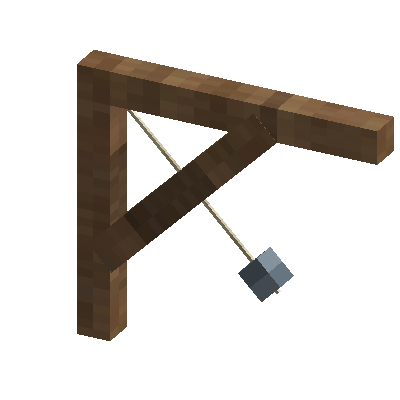
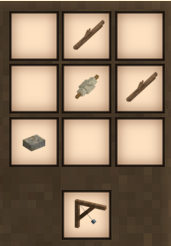
Craft a plumb and square and put it on your hotbar. The recipe is 2 sticks, 1 flax twine, and 1 stone.
Keep at least one reinforcement material anywhere in your inventory. For metals, an ingot and nails and strips give the same strength, but the ingot costs four times as much and adds nothing. Right-click the block with the plumb and square. That consumes one material item.
Remove your own reinforcement with a left-click of the same tool. Another player can remove it only if they have the all permission.
| Material | Strength |
|---|---|
| Gold | 25 |
| Chert, obsidian, and igneous stones | 50 |
| Silver | 100 |
| Copper | 150 |
| Tin bronze and bismuth bronze | 300 |
| Black bronze | 400 |
| Iron | 800 |
| Meteoric iron | 1000 |
| Steel | 1200 |
Locks and access
A lantern or ceramic piece reinforced at any strength can no longer be picked up with right-click.
Bronze, iron, and steel padlocks are smithed on the anvil. Right-click one onto a reinforced door, chest, or reed basket and other players can no longer open it. Do not type the square brackets in the commands below — they only mark the player or group name.
| Command | What it does |
|---|---|
/bre grant name use |
That player can open your chests and doors. Revoke with /bre revoke name |
/bre grantgroup group use |
The same for a player group. Revoke with /bre revokegroup group |
/bre grant name all |
use, plus the ability to strip your reinforcement with their own plumb and square |
/bre grantgroup group all |
The same for a group |
For the server
Which blocks can be reinforced is set in the block’s JSON. A weak block is enabled with attributes: { reinforcable: true }, — the missing e is intentional; that is how the game spells it. If attributes already exist, add reinforcable: true, inside them. A hard block is disabled with reinforcable: false,.
Wiki videos: an English walkthrough and a German walkthrough.