


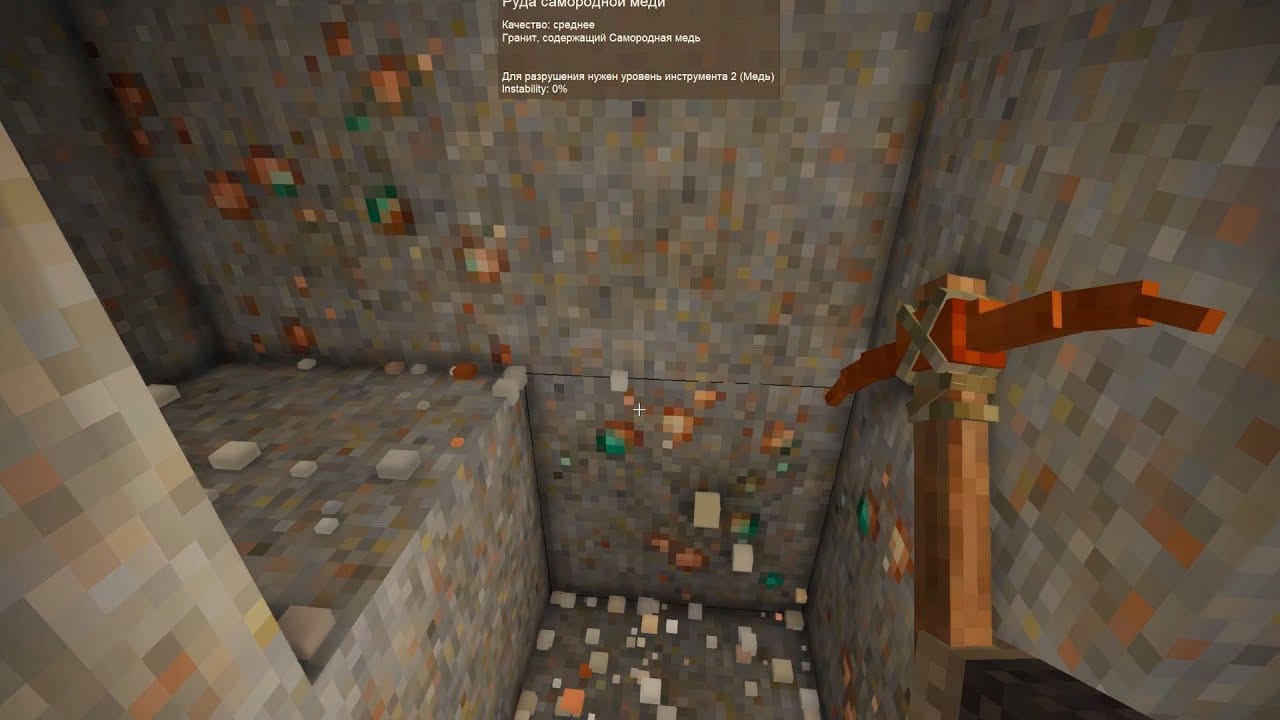
Copper is the first metal that lets you mine stone and ore properly in Vintage Story. Until you have a copper pickaxe, rock barely breaks and underground veins stay out of reach. Casting the first tools takes nuggets, fired clay molds, a crucible, and a fuel that can hold copper’s melting point of 1084 °C. Firewood and peat cannot do that. You need charcoal, coke, or coal.
What to prepare before you smelt
The minimum set for the first two tools — a pickaxe and a hammer — is:
- 40 copper nuggets (20 for each head);
- any clay: red, blue, or fire clay;
- dry grass, sticks, and firewood for a pit kiln;
- wooden tongs: 6 sticks and 1 rope in the crafting grid;
- a firepit to hold the crucible.
One nugget is 5 units of metal. A tool head and an ingot each take 100 units, which is exactly 20 nuggets. An anvil takes 900 units (180 nuggets), so leave that until you have copper to spare.
Where to find copper nuggets
You do not mine the first copper with a pickaxe. You pick it up on the surface or pan it out of sand and gravel.
- Surface stones. Malachite and native copper leave loose bits. Each bit gives 1–3 nuggets, and you can collect them with an empty hand. Check slopes, cliffs, and exposed rock.
- Panning. Sand and gravel have about a 15% chance to yield a native copper nugget. It is slow, but it fills the gaps.
- Commodities trader. 1–3 rusty gears buy a stack of 16 nuggets. The trade can be repeated 3–5 times before the stock resets.
- Cracked ore vessels in ruins. These have about a 14.5% chance to hold 2–8 copper nuggets.
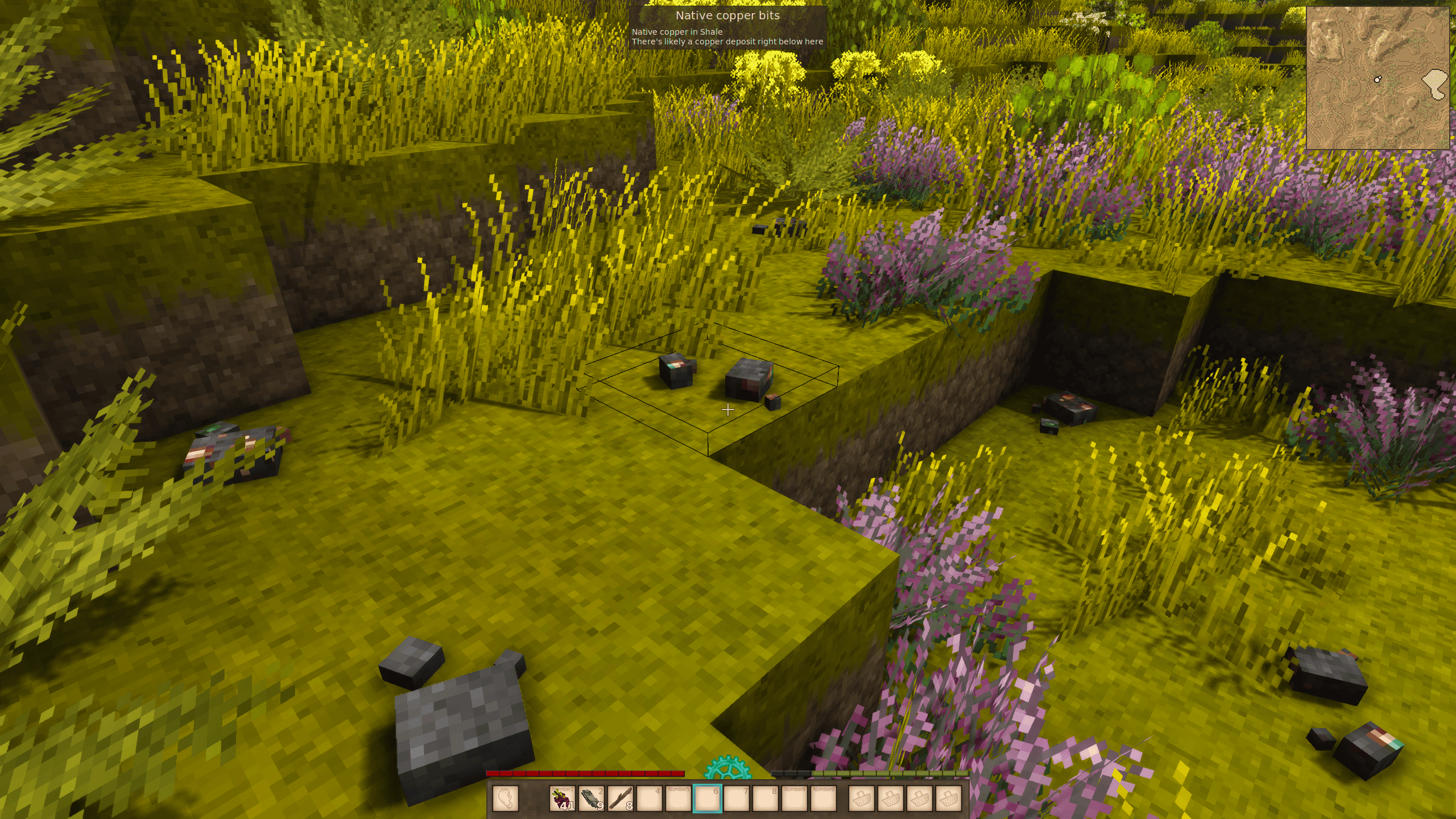
The vein under those stones stays sealed for now. Stone and ore need a copper pickaxe or better. The first 40 nuggets almost always come from the surface and from panning. After that, you come back and dig down.
Molds and the crucible
Molds and the crucible are formed from clay, then fired. Any clay works for copper tools: red, blue, or fire clay. Red clay usually sits in thick soil in temperate or warmer climates with rain. Blue clay generates in the same conditions below sea level. Fire clay shows up around bauxite sand and under black coal and anthracite.
How to form an item:
- Hold clay in your hand.
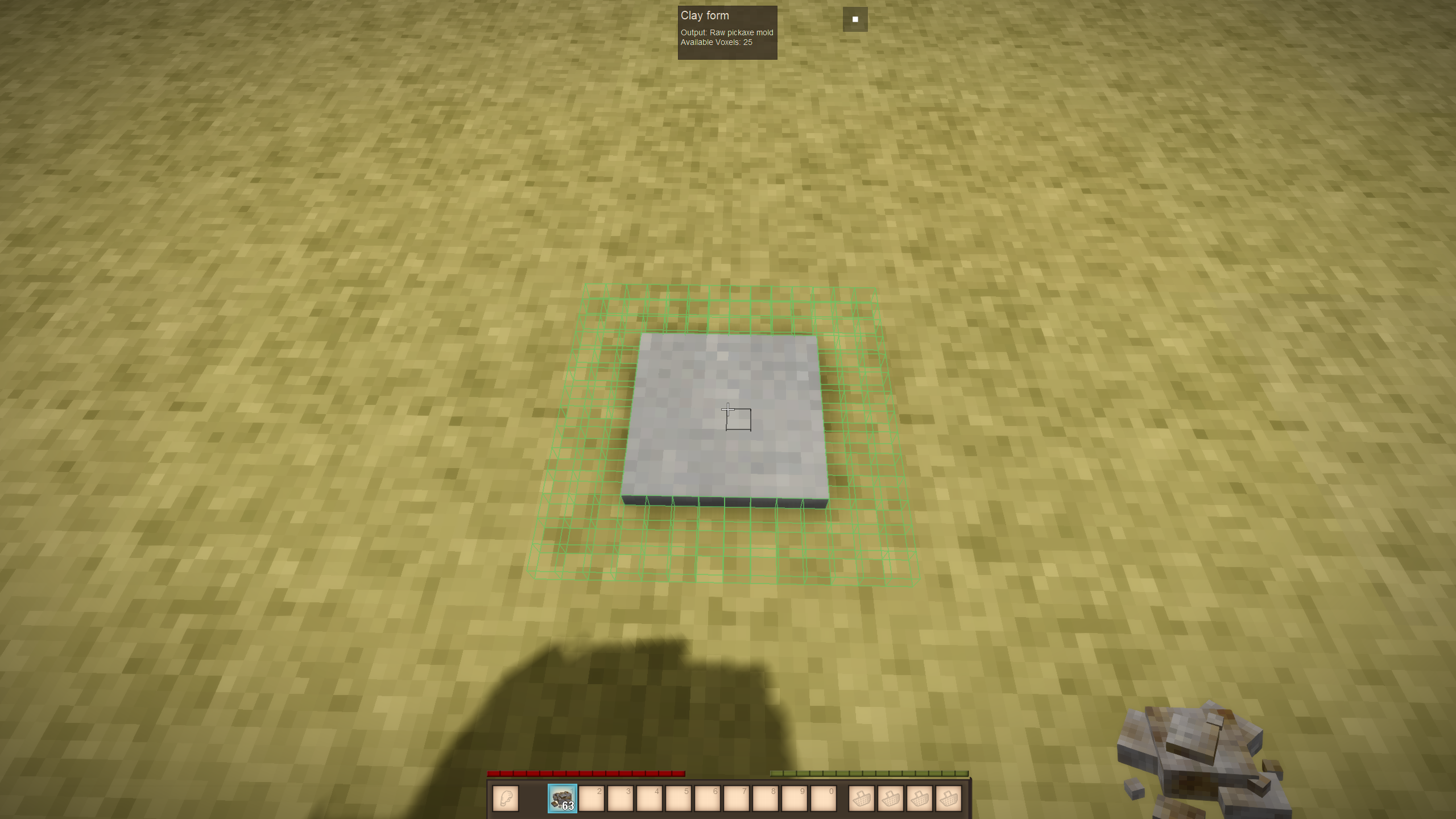
- Aim at a solid block and open the clay forming menu. Pick the crucible or the mold you need.
- A grid appears on the block. Fill the green cells with clay and remove the orange ones.
- When a layer is done, the next one appears above it. Sit with G so you do not shift while you work.
- Press F to change the brush size: 1×1, 2×2, or 3×3. Copy mode repeats the pattern of the layer underneath, which makes molds much faster.
- The finished raw piece drops into your inventory. You can set it on the ground; breaking the block does not destroy it.
Clay needed for the starting molds:
| Mold | Clay | Nuggets per cast |
|---|---|---|
| Crucible | 2 (or 13 for four) | — |
| Pickaxe | 12 | 20 |
| Hammer | 12 | 20 |
| Axe | 11 | 20 |
| Shovel | 11 | 20 |
| Hoe | 12 | 20 |
| Ingot | 2 (or 5 for two) | 20 |
| Prospecting pick | 13 | 20 |
For the first session, make a crucible, a pickaxe mold, and a hammer mold. A saw, shears, spear, chisel, and scythe cannot be cast. Those are smithed on an anvil, and the anvil itself costs 180 nuggets.
Firing in a pit kiln
Raw molds and a raw crucible do nothing until they are fired. A pit kiln is a one-block-deep hole in the ground.
- Dig a 1×1 hole.
- Put dry grass and sticks on the bottom, then firewood, peat, or coal on top.
- Place up to four raw clay items inside.
- Light the grass with a torch or a firestarter and seal the hole with a non-flammable block, such as dirt.
Firing takes about 10–20 in-game hours depending on the fuel. The finished ceramic can be taken out. Molds are reusable and do not break after a normal cast.
The charcoal pit
Copper melts at 1084 °C. Firewood and peat never reach that. Charcoal heats a firepit to 1300 °C, which is enough for copper and for bronze. Coal and coke work too, but you usually do not have them yet, so the first smelt is done with charcoal.
How to build the pit:
- Stack firewood in a square. Every stack must hold exactly 32 pieces. Partial stacks produce no charcoal. You can dig a hole or stack the firewood on the ground.
- Seal the stacks with dirt or any non-combustible block on every side except one block on top.
- Build a firepit directly on the open stack. With the block info overlay on, that firepit is now called a charcoal pit. It does not need extra fuel.
- Light it and seal the last opening within 30 seconds. If you miss the window, or if there are gaps inside, the firewood burns to ash instead of charcoal. Open the shell and put the fire out with water.
- After about half a minute, smoke starts seeping through the cover. The process takes 18 in-game hours.
- When the smoke stops, break the shell and collect the charcoal by hand or with a shovel.
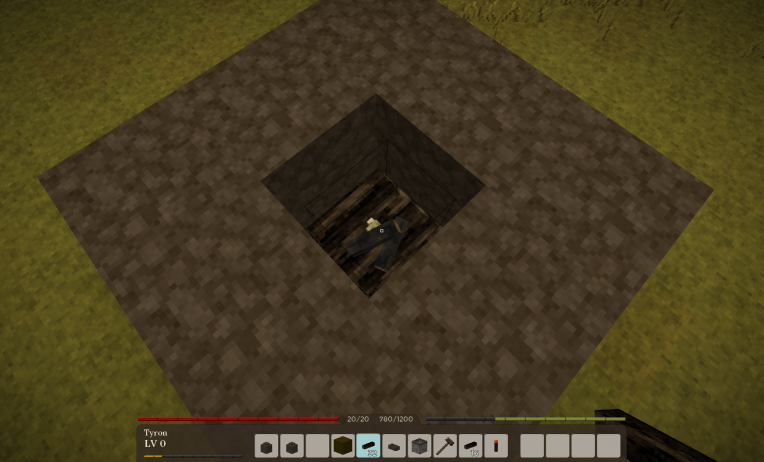
One full stack of 32 firewood yields about 5–6 charcoal on average (anywhere from 4 to 7). That is enough for the first smelt. The pit can be larger, up to an 11×11×11 cube, and the firepit can sit on any stack inside, not only in the center.
Smelting and pouring
Wooden tongs are crafted from 6 sticks and 1 rope. You cannot handle a glowing crucible without them. Equip the tongs in the off-hand.
- Place the fired crucible in the left slot of the firepit. The crucible window opens with four slots.
- Add the nuggets. One head takes 20 nuggets (100 units of metal). A crucible can heat only one metal or one alloy at a time.
- Add charcoal and light the firepit. When the copper melts, the glowing crucible moves to the right slot.
- Hold the crucible with tongs in your main hand and pour into a mold sitting on a solid block. A full mold will not take more metal.
- Wait until the metal cools to cold, then take the item out with right click. The mold can be used again.
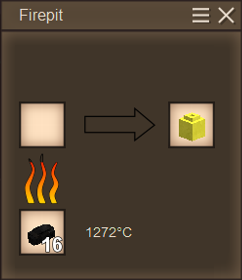
Adding or removing nuggets after heating has started resets the temperature. A crucible taken off the firepit and not poured will cool down: the metal turns solid again and has to be reheated. A partly filled mold cannot be picked up. Breaking it wastes the metal inside.
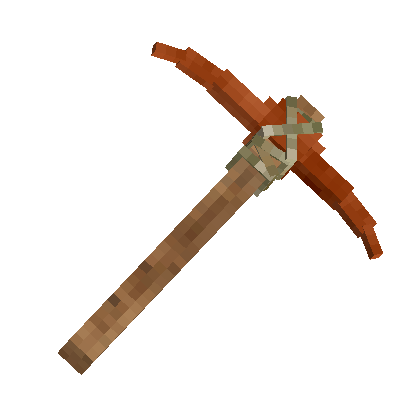
Cast the pickaxe and the hammer first. The pickaxe opens stone and the ore under surface bits. The hammer crushes ore chunks into nuggets. An axe, shovel, and hoe are cast the same way, at 20 nuggets each. A saw, shears, and a spear cannot be cast. Those need an anvil and smithing.
Source: Casting, Charcoal, and Clay forming on the Vintage Story Wiki (CC BY-NC-SA).