


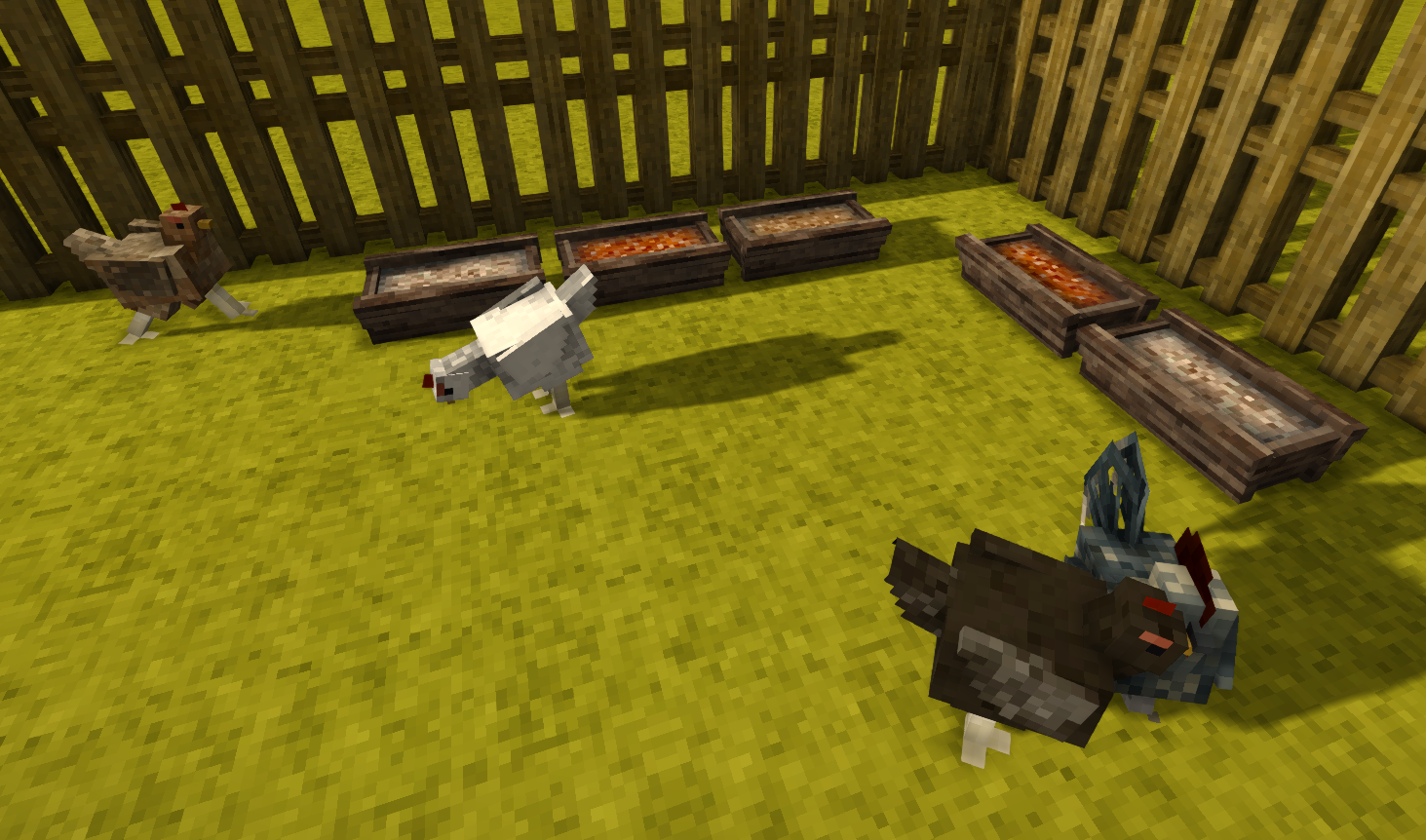
Animal husbandry in Vintage Story means breeding and domesticating animals by feeding them from a trough. You need a male and a female: the female must eat the required portions after reaching “Ready to mate,” and the male needs at least one portion to start mating. Animals do not starve to death, but without food they lose weight, and butchering yields less meat, hide, and fat.
Basics
- Generation is inherited from the mother only (+1 over the mother’s generation). The father does not affect it.
- One or two males are enough for a herd; mating range is up to 10 blocks, so the male can stay in a neighboring pen.
- Keep animals of the same generation in separate pens — it makes breeding control easier and keeps bloodlines from mixing.
- Animals eat from about 0.6 blocks away; creature weight does not affect breeding ability.
- Animals disappear if left in darkness too long — use lamps, lanterns, or daylight.
Generations and domestication
Wild animals are generation 0. As generations rise, aggressive species stop attacking unprovoked, and flighty ones fear the player less.
| Generation | Effect |
|---|---|
| 1 | Can be pet; cleaver sometimes kills in one hit |
| 2 | Can be led with a rope |
| 3 | Pigs are not aggressive near piglets; milking is safe; cleaver kills in one hit |
| 5 | Babies and small animals can be picked up in a reed chest |
| 10 | No longer fear the player; aggressive animals become neutral; roosters stop fighting each other |
An animal in a reed chest can be held for up to 24 in-game hours or it dies. For longer trips, release it to recover — recovery takes half as long as the time spent in the chest.
Feeding
- Chickens and hares eat from a small trough: chickens — grain, hares — vegetables (including items dropped on the ground nearby).
- Pigs, sheep, and goats use a large trough. Large-trough portions usually cost 2 food items each (grass/hay and pumpkin slices count differently).
- One portion is enough for a male to mate with several females; the female’s consumed portions reset after pregnancy.
- Pigs do not eat rice or parsnips; sheep and goats eat grass, grains (except rice), vegetables (except parsnips), and fruit mash.
What to breed
| Animal | Purpose | Notes |
|---|---|---|
| Pigs | Meat, hides, fat | 2–6 piglets (often 4–6); best meat livestock. Near piglets, wild and early generations are aggressive — this stops after generation 3 |
| Sheep / goats | Milk → cheese | Cheese: milk + pickled vegetables + salt. Milk with a bucket once per day |
| Chickens | Eggs and feathers | Need a rooster and a henbox: 3 fertilized eggs, 5 days of incubation. Without a henbox, eggs on the ground vanish after 48 hours |
| Hares | Mostly useless | Hides are easily replaced by other resources; breeding is inefficient |
Efficient culling cycle
- Pigs: after farrowing you can slaughter the sow immediately; butcher the piglets when grown, keeping one sow and 1–2 boars.
- Chickens: keep chicks and a rooster for the next cycle.
- Sheep / goats: slaughter the female once her offspring has grown into an adult female — so the milk line continues.
Drop amounts depend on creature weight (Good / Decent / Low / Starving). Keep livestock well fed, especially in winter and cold climates.
Preserving meat
To keep meat longer: salt or stew it, put it in crocks, and seal with wax or fat.
Timings
By default a month is 9 days. Gestation, maturity, and mating cooldowns scale if world settings change. Newly matured animals are not ready to mate immediately.
| Animal | Portions | Gestation | Litter | Maturity |
|---|---|---|---|---|
| Hare | 2 | 5 d | 1–4 | 14 d |
| Chicken | 4 | 5 d* | 1* | ~8 d |
| Pig | 10 | 25 d | 2–6 | 7 d |
| Sheep / goat | 10 | 20 d | 1 | 14 d |
*Chickens: eggs in a henbox; incubation runs for 5 days only while a hen is brooding — disturbing her delays the process.
Milking
Sheep and goats lactate for 21 days after giving birth, at most once per day. Before generation 3 the female may become aggressive when milked; from generation 3 milking always succeeds. Drink milk from a bucket or bowl, or turn it into cheese for long-term storage.