


How to Survive Your First 5 Days in Vintage Story
The first few days in Vintage Story set the foundation for your entire playthrough. This guide provides a practical day-by-day roadmap that will help new players establish a secure base, gather resources efficiently, and prepare for future technological advancement.
Before You Begin
- Press H to open the Handbook for crafting recipes and game information. It also pauses the game.
- Use Shift to crouch and approach animals more carefully.
- Ctrl activates sprinting but consumes hunger more quickly.
- Press G to sit down and reduce hunger consumption while working.
- C displays your character and world statistics.
- M opens the world map. Enabling "Color Accurate" in the settings makes locating clay and peat much easier.
- Don't waste nights sleeping. Use the time for crafting, organizing, and planning.
- Torches can last indefinitely if you regularly pick them up and place them again before they expire.
- Many materials can fuel your campfire, including peat, firewood, and even ferns.
- Death is part of the learning process in Vintage Story. Don't let it discourage you.
Day 1 – Establish Your Shelter
Start by knapping a stone knife and stone axe. Then gather enough cattails to craft two handbaskets and one chest.
Look for a nearby lake with cattails, but don't spend too much time searching for the perfect base location. A relatively flat area is sufficient for your first shelter.
Place your chest and store valuable resources such as flint, berries, vegetables, and fat inside. Other materials can be stacked nearby on the ground.
Next, collect:
- berries and mushrooms;
- sticks for torches, a shovel, and a backup knife;
- clay for a cooking pot, bowl, and storage vessel;
- grass for two hay bales;
- dead birds and any useful materials you encounter.
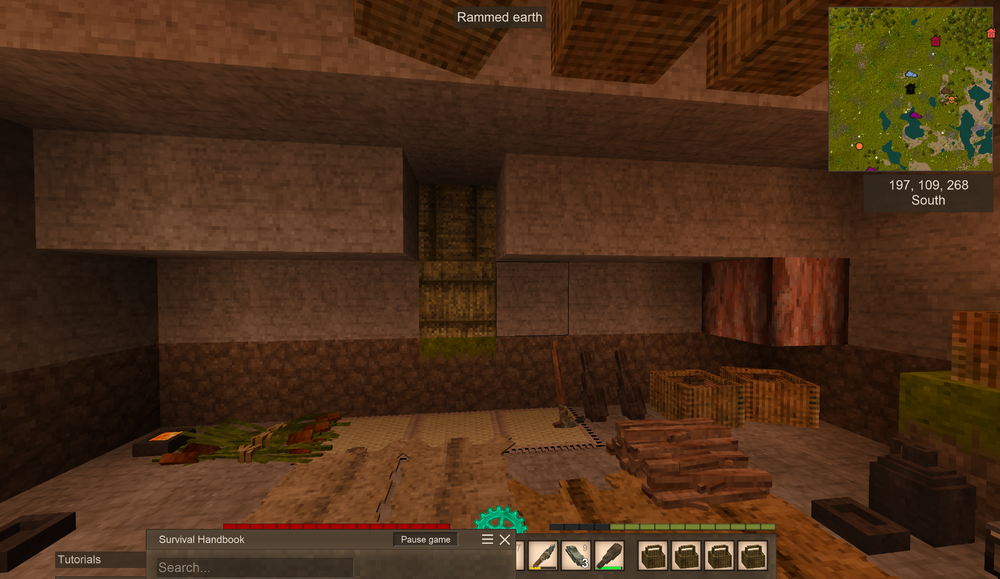
Return to camp and construct a simple 10×7 shelter with an 8×5 interior. Raise the walls, lower the floor by one block, and build an A-frame roof. This design provides safety while functioning as a cellar for food preservation.
Once complete:
- organize your inventory;
- place two torches inside;
- shape a storage vessel, cooking pot, and bowl from clay;
- cook any poultry you found;
- avoid overeating and maintain your hunger around half full.
Day 2 – Expand Your Resources
Leave your shelter after 5:00 AM.
Your objectives include:
- building one or two pit kilns;
- cutting down trees for logs and sticks;
- collecting additional cattails for another basket and chest;
- gathering more clay for a watering can and jug;
- hunting a bird or raccoon;
- collecting wild crop seeds;
- finding medium fertility soil and several pieces of peat.
During the evening, craft your watering can, jug, crock, club, pan, and prepare replacement tools or torches as needed.
Day 3 – Start Farming
Begin planting your collected seeds while keeping crop types grouped together whenever possible.
Gather more cattails to expand storage capacity, fire your pottery in pit kilns, and hunt another animal.
At night:
- reorganize inventories;
- craft rough-hewn fencing;
- make four or five spears;
- consider crafting improvised armor;
- spend time exploring the in-game Handbook.
Day 4 – Hunt Larger Game
Continue firing pottery while preparing for larger hunts involving deer, goats, or boars.
- Use spears from a distance against deer and goats.
- Against boars, begin with a spear and finish the fight using a club.
In the evening, cook red meat stew, oil any hides with fat to preserve them for future clothing, and move vegetables and other perishables into your storage vessel inside the cellar.
Day 5 – Prepare for Long-Term Survival
Expand your farm with additional medium fertility soil, plant newly acquired seeds, and surround the fields with fencing.
Continue hunting, replenish wood and fuel supplies, check your pit kilns, and mark resin-producing pine trees on your map for future use.
Take some time to explore farther from home. With a functioning shelter, food storage, and pottery production established, you're now in a strong position to begin broader exploration.
Where to Go Next
By the end of your first five days, you should have a reliable base of operations, organized food storage, basic farming, and pottery production. From here, you can begin searching for copper, advancing through metallurgy, improving your farm, and exploring the deeper technology progression available in Vintage Story.