


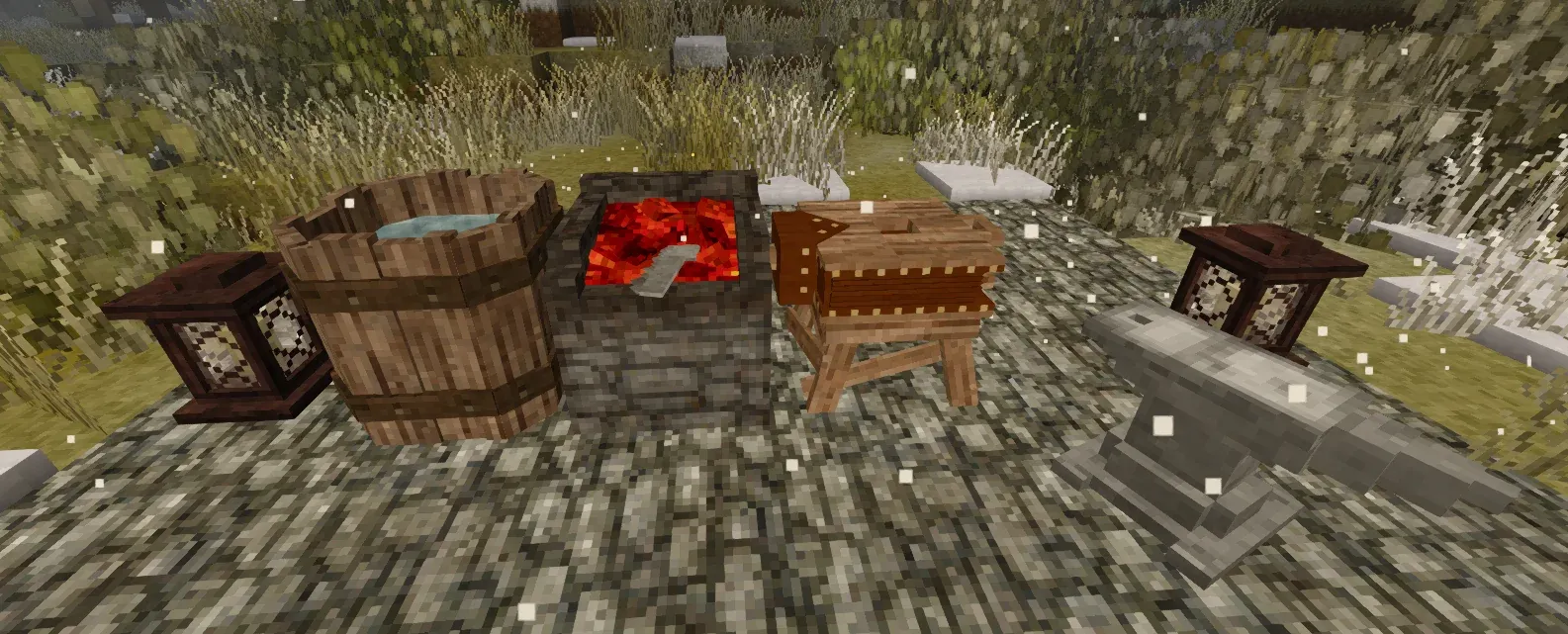
Quenching and Tempering
Quenching and tempering are metalworking mechanics that allow tools and weapons to gain additional properties. In Vintage Story, these processes can only be applied to tools and weapons made from iron, meteoric iron, or steel.
Quenching can improve either the power or durability of an item, but not both at the same time. Each quench also increases the chance of the tool head shattering during cooling. This risk can be reduced through tempering.
Tempering reduces the accumulated shatter chance, but also lowers the power bonus gained from quenching. A durability bonus gained through quenching is not reduced by tempering.
Required Materials
- a forge;
- coal or a suitable coke variant as fuel;
- bellows;
- a water source — either a water block or a water-filled barrel;
- fire clay — optional.
Only a forge and fuel are required for tempering.
How Quenching Works
Before quenching, decide which property you want to improve.
If you coat a cool tool head with fire clay in the crafting grid, quenching will improve its durability. If you do not use clay, quenching will improve the item's power.
1. Apply Fire Clay
This step is optional. Use fire clay if you want to gain a durability bonus. If you want a power bonus, leave the tool head uncoated.
2. Heat the Tool Head
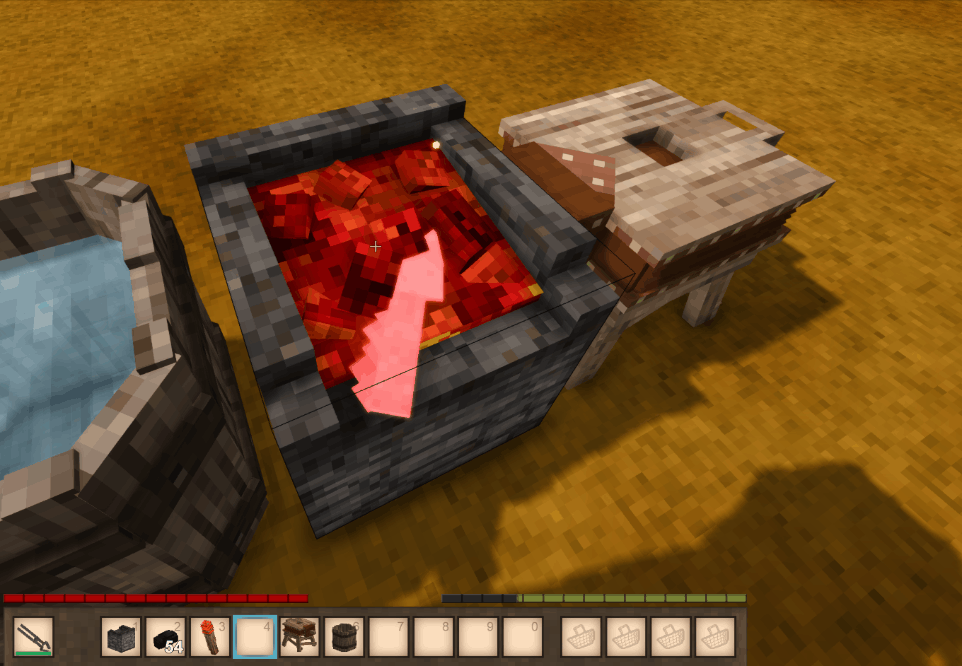
Place the tool head into a forge and add fuel. Light the fuel and use the attached bellows to heat the tool head to a temperature between 815 °C and 1050 °C.
3. Cool the Tool Head Quickly
Remove the hot tool head from the forge and quickly cool it in the nearest water block or water-filled barrel.
For a successful quench, the temperature must be brought below 100 °C quickly. Continue quenching until the sizzling sound and bubbles disappear. In the current version, the animation may reset during the process, so stopping too early can interrupt the quench.
Shattering Risk
Quenching creates internal stresses in the metal. Each quench adds 5% to the chance of the tool head shattering while cooling.
An item can be quenched an unlimited number of times, but the shatter chance consistently increases while the benefits gained from each additional quench become smaller.
The shatter risk only applies to quenching. Tempering itself cannot cause the item to shatter.
After a successful quench, the bonus gained and the number of times the item has been properly quenched are shown in its tooltip. If the tool head shatters during quenching, some material will be lost.
How Tempering Works
Tempering is used to reduce the shatter chance accumulated through quenching.
The process is similar to quenching, but it uses a lower temperature and requires much slower cooling. After heating, simply allowing the item to cool in the air is sufficient.
1. Heat the Tool Head
Place the tool head into a forge and add fuel. Heat it to a temperature between 550 °C and 700 °C.
2. Allow the Tool Head to Cool
Remove the tool head from the forge and allow it to air-cool to 200 °C or lower. The item can be placed on the ground or held in your hand while it cools.
Successful tempering slightly reduces the shatter chance for the next quench. If quenching provided a durability bonus, that bonus remains unchanged. If quenching provided a power bonus, the power bonus will be reduced slightly.
The reduction in shatter chance is greater than the reduction in the power bonus. An item cannot be tempered more times than it has been quenched.
Quenching with Fire Clay
The table below shows the values for consecutive quenches performed with fire clay. In this case, the item's durability is increased.
| Metal | Base Durability (Pickaxe) | First Quench | Shatter Chance | Average Gain | Second Quench | Shatter Chance | Average Gain | Third Quench | Shatter Chance | Average Gain |
|---|---|---|---|---|---|---|---|---|---|---|
| Iron | 100% (1000) | 120% (1200) | 5% | (1000 × 20%) − (1000 × 5%) = 150 | 136.7% (1367) | 10% (8% Tempered) | (1000 × 16.7%) − (1200 × 8%) = 96 | 151% (1510) | 13% (10.5%) | (1000 × 14.3%) − (1367 × 10.5%) = −0.535 |
| Meteoric Iron | 100% (1300) | 120% (1560) | 5% | (1300 × 20%) − (1300 × 5%) = 195 | 136.7% (1777) | 10% (8% Tempered) | (1300 × 16.7%) − (1560 × 8%) = 124.8 | 151% (1963) | 13% (10.5%) | (1300 × 14.3%) − (1777 × 10.5%) = −0.685 |
| Steel | 100% (2500) | 120% (3000) | 5% | (2500 × 20%) − (2500 × 5%) = 375 | 136.7% (3418) | 10% (8% Tempered) | (2500 × 16.7%) − (3000 × 8%) = 240 | 151% (3775) | 13% (10.5%) | (2500 × 14.3%) − (3418 × 10.5%) = −1.39 |
Tips
- Use fire clay when you want to increase durability.
- Do not use clay when you want to increase power.
- Carefully watch the temperature before quenching and stay between 815 °C and 1050 °C.
- After starting the cooling process, continue quenching until the sizzling sound and bubbles disappear.
- Use tempering before another quench to reduce the accumulated shatter chance.
- Remember that tempering reduces the power bonus but does not reduce the durability bonus.
Quenching and tempering were introduced in version 1.22 alongside iron and steel spears.