


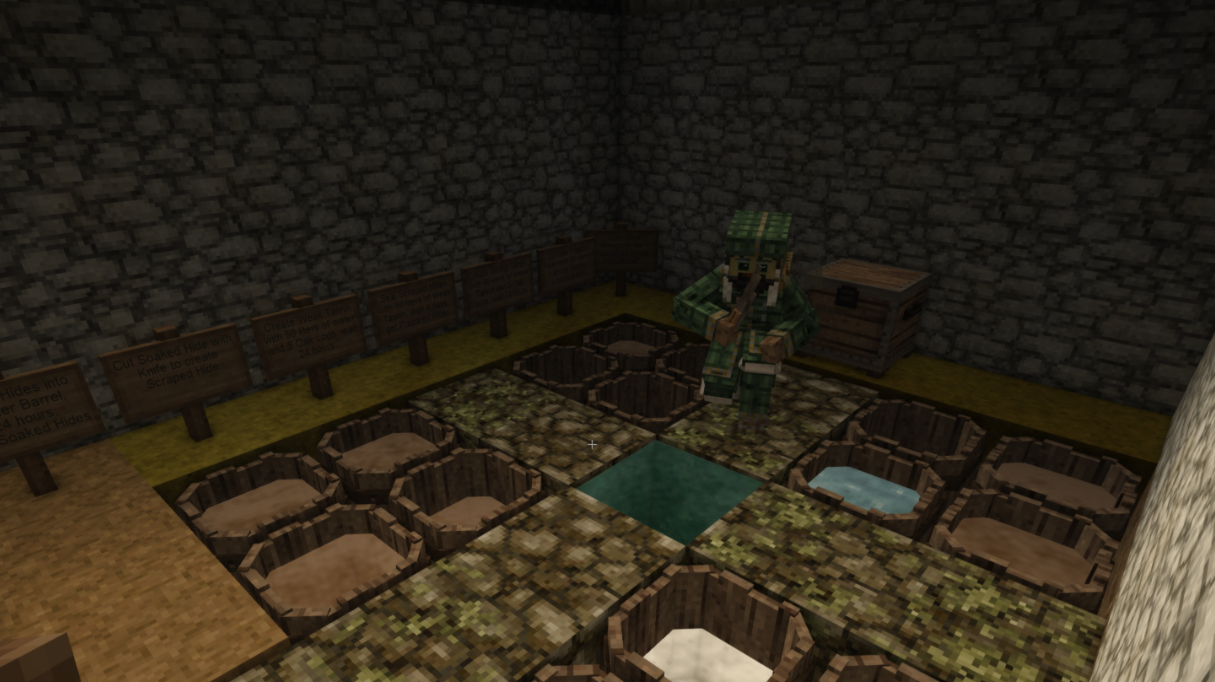
Leather in Vintage Story does not drop from an animal. The drop is a raw hide, and it has to be sealed in a barrel more than once: first in limewater or diluted borax, then in weak tannin, then in strong tannin. One barrel holds one size only. Small, medium, large, and huge hides drink different amounts, and they cannot be mixed.
Hides come from wild and domestic animals. The size is written on the item.
Animal husbandry: efficient breeding
What you need
A barrel holds 50 liters, which is five wooden buckets. A bucket carries 10 liters, a bowl one. Right click moves the liquid. Lime is ground in a quern: one limestone, chalk, or marble stone gives one lime, and a shell gives two. One piece of borax gives two powdered borax. A commodities trader also sells lime.
Quicklime is not for leather. It is baked from lime for mortar and plaster. The barrel wants ordinary lime, or powdered borax.
Tannin is made only from oak logs or acacia logs. Other wood is refused. You also need a knife, to scrape the hide after the first soak.
| Hide size | Liquid per hide | Fits in 50 L | Leather from one hide |
|---|---|---|---|
| Small | 2 L | 25 | 1 |
| Medium | 4 L | 12, with 2 L left | 2 |
| Large | 6 L | 8, with 2 L left | 3 |
| Huge | 10 L | 5 | 5 |
Hares and young animals drop a small hide. An adult wolf or hyena drops a medium one. Deer, goats, pigs, and sheep vary with the animal itself: the drop can be small, medium, or large. A moose is usually large. Fox, arctic fox, and raccoon hides are their own small items, not the generic hide. A bear hide is its own item too, and it still has the head.
Lime or borax
Each liter of water needs one lime. Powdered borax is only 0.4 per liter, but you cannot add a fraction of an item, so take the next whole piece. Water and powder become the solution at once. No sealing yet.
| One hide | Water | Lime | Powdered borax, rounded up |
|---|---|---|---|
| Small | 2 L | 2 | 1 |
| Medium | 4 L | 4 | 2 |
| Large | 6 L | 6 | 3 |
| Huge | 10 L | 10 | 4 |
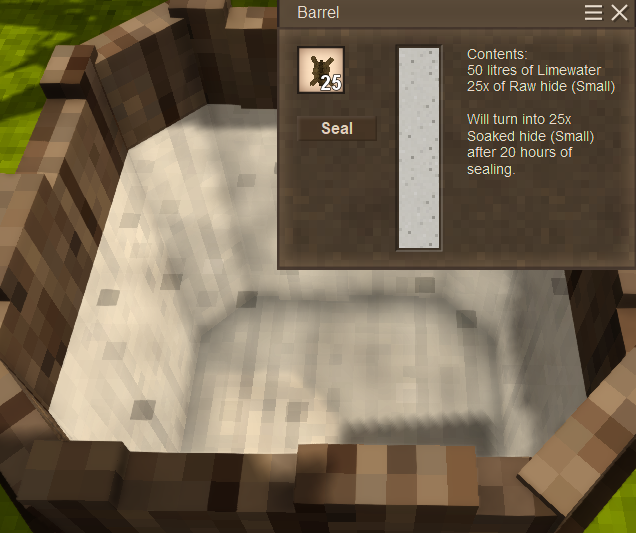
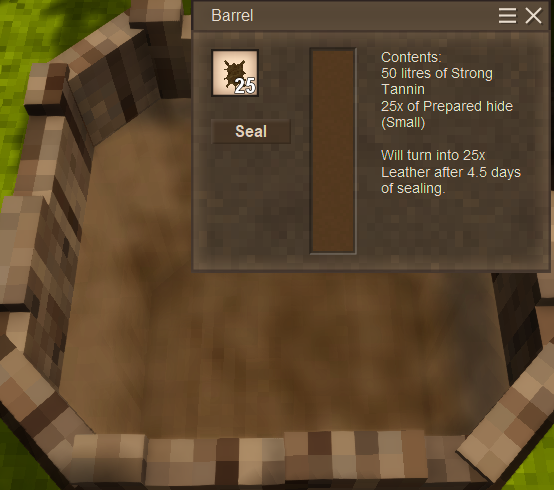
A full barrel of small hides, 25 of them, takes 50 lime or 20 powdered borax. Put the hides into the finished solution and press Seal. After 20 in-game hours they are soaked hides. The screenshot is the English barrel window: 50 liters of limewater and 25 small raw hides.
Start the tannin now
While the hides sit in lime, another barrel can already be making tannin. One oak or acacia log and 10 liters of water become 10 liters of weak tannin in 24 hours. One more log and 10 liters of weak tannin become 10 liters of strong tannin in another day. You cannot add part of a log, so brew tannin in 10 liter batches and keep the extra for the next hides.
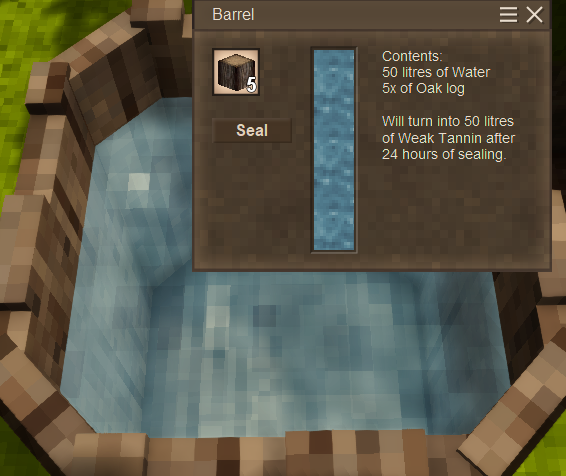
Each hide needs as many liters of weak tannin as it needed water in the first bath, and the same amount of strong tannin. Strong tannin is brewed from that same volume of weak tannin, so you make twice as much weak tannin as the hide itself will soak in.
| One hide | Weak tannin for the hide | Strong tannin | Logs, if you brew without storing extra |
|---|---|---|---|
| Small | 2 L | 2 L | 1, with some left over |
| Medium | 4 L | 4 L | 2 |
| Large | 6 L | 6 L | 2 |
| Huge | 10 L | 10 L | 3 |
A leather backpack takes 8 leather. Eight small hides produce exactly that. They need 16 lime, or 7 to 8 powdered borax, which is four pieces of borax, and about six oak or acacia logs.
A knife, then two more baths
Take the soaked hides out and put a knife above them in the crafting grid. The same scrape can be done on the ground when the recipe appears there. The result is a scraped hide. A fox, arctic fox, or raccoon gives one small scraped hide. A bear hide gives huge scraped hides, and more than one.
| Soaked bear hide | Huge scraped hides |
|---|---|
| Sun bear or panda | 2 |
| Black bear | 2 |
| Brown or polar bear | 3 |
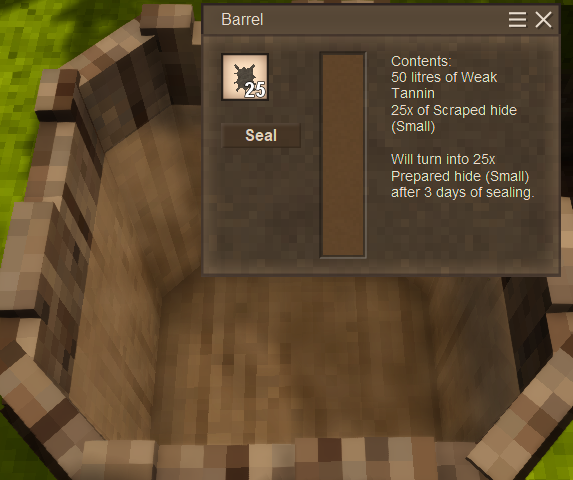
Seal the scraped hides in weak tannin for 3 in-game days. They become prepared hides. During that soak, the spare weak tannin has time to become strong tannin.
Move the prepared hides into strong tannin and seal them again, this time for 4.5 days. The barrel then holds leather. Every timer here is in-game time.
Handbook icons for hides are easy to mix up. Hover the picture in a recipe and the label tells you whether it is raw, soaked, or already scraped. Move the cursor away and the recipe starts cycling through the variants again.
Where the leather goes
Eight leather makes a leather backpack, with six slots. The forge's small bellows are leather too: planks, nails and strips, and the leather itself. Crude hide bellows do not use leather. They need a large or huge pelt.
The forge and anvil in Vintage Story
Sturdy leather does not come out of this barrel. That is a later recipe. Ordinary leather also goes into bows, a shield, a saddle, a sling, clothes, and dye.
A pelt is not leather
Fur clothes, lamellar armor, and the hunter backpack skip the barrel. Oil the hide in the crafting grid with rendered fat. A lump of raw fat will not do. One lump of rendered fat covers four small hides, two medium hides, or one large hide. Fox, arctic fox, and raccoon hides are also four to a lump. A sun bear or panda needs one lump. A black, brown, or polar bear needs two.
An oiled hide becomes a pelt after 48 hours. Where you store it does not matter, and it no longer rots. Hover the item to see the progress. A bear pelt still has the head at first: a knife splits the head from the body. The hunter backpack has four slots.
A raw hide with no bath and no fat is still used, but only for the simplest clothes. It is not finished leather, and it is not a pelt.
The volumes, the timers, and the yields follow the wiki articles Leather working and Pelt. Item names follow the English client in 1.22.7. That wiki text is licensed CC BY-NC-SA.