


Ore in Vintage Story sits in thin discs inside a particular rock. A cave can cut the edge of one, but wandering tunnels is a slow way to find metal. The prospecting pick does the searching: first it tells you whether the district is worth digging, then it names a vein a few blocks from the block you broke.
The first copper often shows up before you own a pickaxe. Native copper bits and copper ore bits lie on the ground. Pick them up with an empty hand or break them, then mark the spot. A copper disc is in the stone below. More nuggets come from a Cracked vessel (Ore) in ruins, from a commodities trader, and from panning sand. Those nuggets are what you cast into the first pickaxe and the first prospecting pick.
Casting copper: nuggets, molds, the crucible, and the charcoal pit
Tin, bismuth, and zinc are the three bronzes. Lead is its own metal, and its discs can hide silver. Iron is the bloomery.
The three bronzes: crucible ratios
The two modes
The tool is the Copper prospecting pick. Later you cast or smith the same head in bronze, iron, and steel, and the better metal simply lasts longer. The tool-mode key is F by default. The menu says Density Search Mode and Node Search Mode. The longer lines are Density Search Mode (Long range, chance based search) and Node Search Mode (Short range, exact search).
The prospecting pick drops nothing. The block it breaks is gone. A pickaxe drops the ore chunk.
Density search
Break three rock blocks. Keep the samples between 3 and 16 blocks apart. After the first, chat says “Ok, need 2 more samples”. After the second, “Ok need one more sample”. Walk farther than 16 blocks and the set starts over: “Sample too far away from initial reading. Sampling around this point now, need 2 more samples.”
The reading belongs to the whole column of rock at the first sample, from the surface to the mantle. Sampling higher or lower on that same vertical line does not change the number. A new reading every 30 to 100 blocks is enough to see the edge of a field and the middle, where both the word and the permille are strongest. The reading stays on the map after the ore is mined out.
A line looks like “Decent Bismuthinite (1.9‰)”. The number is a permille: how many blocks of that ore sit in 1000 blocks of rock in the column. 1.9‰ is 1.9 blocks per thousand. The word compares the spot with how common that ore usually is. A “Very poor” reading of a common ore can be a higher permille than an “Ultra high” reading of a rare one. Read both. “Minuscule amounts of …” has no number. The chance is real and tiny.
| Word in chat | How to read it |
|---|---|
| Ultra high | Among the best ground for this ore |
| Very high | Clearly richer than a typical field |
| High | Worth staying and searching for a node |
| Decent | The middle. Look nearby for a stronger reading |
| Poor | The edge of a field, or a thin district |
| Very poor | Almost empty for this ore |
| Minuscule amounts of | No permille. A tiny chance |
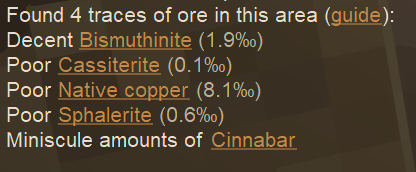
Density search does not report surface copper, quartz itself, or lapis lazuli. It also skips a deposit whose share of the ore map is under 2.5%. Deep copper, tin, bismuth, zinc, lead, iron, malachite, gold, and silver do show up in this reading.
Node search
Node search breaks one block and scans a small cube around it. The default radius is 6, so the cube is 13 blocks wide, tall, and deep. If chat names an ore, that ore is inside the cube. The message does not tell you which way to dig. An empty scan says “No ore node nearby”. A hit starts with “Found the following ore nodes”.
| Line | Ore blocks in the cube |
|---|---|
| Trace amounts | 1–9 |
| Small amounts | 10–19 |
| Medium amounts | 20–39 |
| Large amounts | 40–79 |
| Very large amounts | 80–159 |
| Huge amounts | 160 or more |
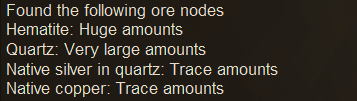
Node search spends two durability. Density search spends one. A radius past 6 scans thousands of blocks and can freeze the game for a moment. Changing that radius is its own note.
How to change the prospecting pick search radius
Which rock holds which ore
A disc is usually one block thick and follows the ground. On flat land a vertical shaft crosses more discs than a horizontal tunnel at one height. Bauxite holds no ore. The handbook page for a rock lists what can generate in it.
Basalt often caps the column, then sedimentary rock, then phyllite and slate, then andesite, granite, and peridotite, with kimberlite toward the mantle. Basalt can sit over other stone, so the first rock under the grass is not the whole column.
| Ore in the rock | Where the grade is highest | Where else it generates | Bits on the ground |
|---|---|---|---|
| Native copper ore | Basalt, bountiful. Basalt skips the rich grade | Sedimentary rock up to medium. Andesite, granite, peridotite, phyllite, and slate up to rich. No limestone | Native copper bits, just under the turf |
| Copper ore (malachite) | Limestone, bountiful | White, pink, and green marble up to rich | Copper ore bits |
| Tin ore | Granite, bountiful | Andesite, basalt, peridotite, phyllite, and slate only up to medium. No sedimentary rock | Tin ore bits. Surface tin is always poor and rare |
| Bismuth ore | Basalt, bountiful | Andesite, granite, and peridotite up to rich. Phyllite and slate up to medium | None |
| Zinc ore | Phyllite and slate, bountiful | Sedimentary rock up to rich. Andesite, granite, basalt, and peridotite up to medium | None |
| Lead ore | Chert and shale, bountiful | Sedimentary only: sandstone and claystone up to rich, chalk, limestone, and conglomerate up to medium. Silver can sit inside | Lead ore bits |
| Iron ore, limonite | Chert and shale, bountiful | Basalt up to medium | None |
| Iron ore, hematite | Granite and peridotite, bountiful | Limestone up to rich, phyllite up to medium | None |
| Iron ore, magnetite | Andesite, rich | Chalk, claystone, conglomerate, and slate up to medium | None |
The placed blocks of all three iron ores are named Iron ore. The line under the name is the mineral: Limonite, Hematite, or Magnetite. The chunk then says it outright, as in Poor chunk of Limonite. Zinc, malachite, and the iron ores prefer richer grades deeper down.
Surface copper and surface tin sit just under the grass. Deep copper is in the lower and middle part of the column. Tin under granite is in the middle and upper part. Iron is placed against sea level, so under a tall mountain you dig farther down to reach the same disc. That disc is wide, with a radius of about 26 blocks, and still about one block thick.
Grade and nuggets
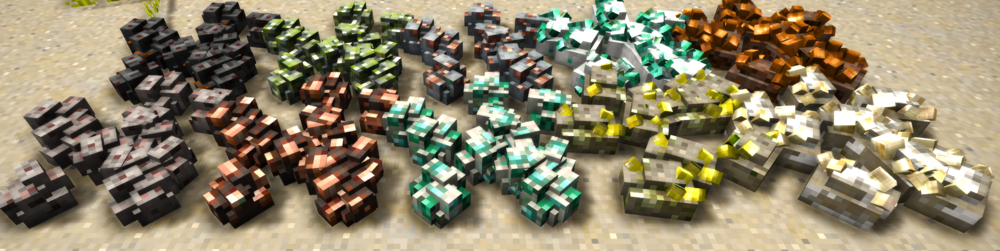
The block in the wall says Quality: Poor, Medium, Rich, or Bountiful. The chunk name joins that grade to the mineral: Poor chunk of Limonite, Medium chunk of Hematite, Rich chunk of Native copper, Poor chunk of Malachite. Native copper ore and malachite’s Copper ore are both copper. After the hammer the nuggets split: Nugget (Native copper) and Nugget (Malachite).
Iron nuggets split the same way: Nugget (Limonite), Nugget (Hematite), Nugget (Magnetite). Put the hammer above the chunk in the crafting grid. One nugget is 5 units of metal.
| Grade | Copper, malachite, bismuth, zinc, lead, limonite, magnetite | Tin | Hematite |
|---|---|---|---|
| Poor | 3 | 1 | 4 |
| Medium | 4 | 2 | 5 |
| Rich | 5 | 3 | 6 |
| Bountiful | 7 | 4 | 8 |
Bountiful tin returns 4 nuggets, the same as a medium copper chunk. Hematite is the generous iron ore. Native gold in quartz returns 1, 2, 3, and 4 nuggets across the four grades. Native silver in quartz returns 2, 3, 4, and 5. Silver pockets in quartz are more common than gold pockets.
Which pickaxe
| Ore | Pickaxe |
|---|---|
| Native copper, malachite, tin, bismuth, zinc, lead | Copper pickaxe |
| Iron, quartz, gold and silver in quartz, borax | A bronze pickaxe |
| Nickel ore | Iron pickaxe |
| Titanium ore, chromite | Steel pickaxe |
Density search does not list quartz. Node search writes “Quartz: …”, and the metals inside it as “Native gold in quartz” and “Native silver in quartz”. Density search can still name those two metals, because they have their own mark on the ore map.
Rocksalt, the Halite block, occurs as a salt dome in sedimentary stone. Density search sees that dome. A dry lake bed in a hot desert, just under the sand, does not appear in density search, and node search does not name the salt. It does name the sylvite inside a dome. The prospecting pick does not find saltpeter. That grows on cave walls.
Borax takes a bronze pickaxe. Powdered borax is the flux for smithing and for the steel coffin. Titanium ore takes a steel pickaxe. Crushed, it is Crushed ilmenite for refractory brick.
Steel: the cementation furnace and blister steel
A Mining bag and a Sturdy mining bag hold only stones, ores, minerals, and metals. In a cave the same discs show in the walls. Bring ladders and light. Temporal stability falls faster as you go deeper.
Digging is described from the wiki Mining, deposits and host rocks from the wiki Ore Deposits, the prospecting pick from the wiki Prospecting pick, and stone layers from the wiki Rock strata.