


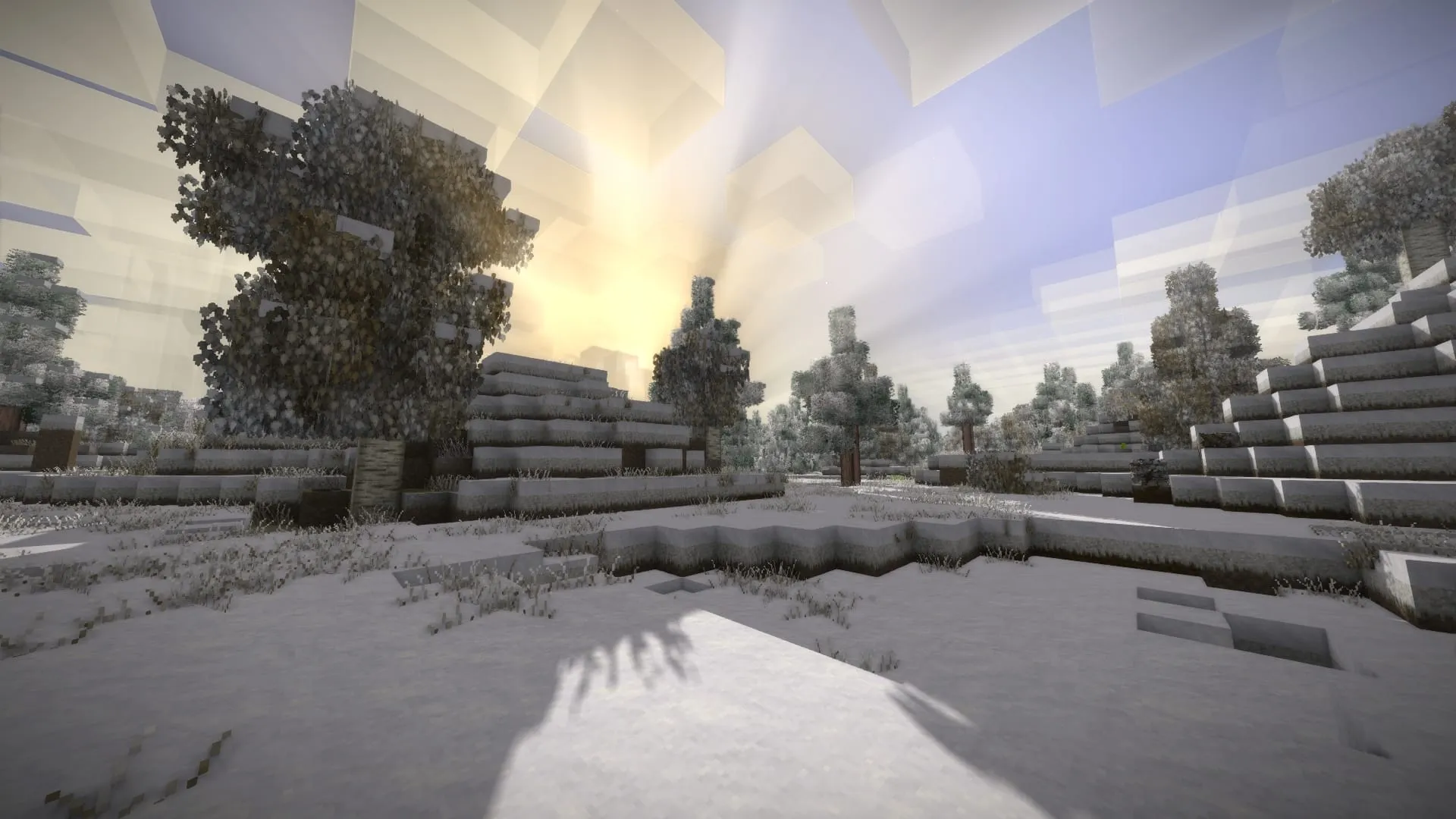
The cold outside the window in Vintage Story is worth learning to read. The same field feeds you in May and goes quiet in January: crops stiffen, bees sleep, snow covers the grass, and you start to shiver. You can see it coming, before the year turns.
The number outside
The C key opens the character screen. Three lines hold the whole year: “Date”, “Outside Temperature”, and “Rainfall in this Area”. The temperature there is the air right now, at your feet. It is not the average for the year.
The average is chosen when the world is created, under “Starting climate”. A usual start is “Temperate (6-14 °C)”: somewhere between six and fourteen across the year. “Hot (28-32°C)” and “Warm (19-23 °C)” barely have a winter. “Cool (-5 to 1 °C)” and “Icy (-15 to -10 °C)” are already cold on average, and January pulls them lower still. That setting applies when “Climate distribution” is “Realistic”: colder to the north, hotter to the south, and east and west feel much the same. “Patchy” paints heat and cold in patches, right against each other.
With admin rights, /wgen pos climate shows both today’s number and the yearly average where you are standing.
Through the day, the coldest hour is about four in the morning, and the warmest about four in the afternoon. In a dry land, day and night drift about nine degrees either way. Where rain hardly ever stops, the gap shrinks to about two and a half. A mountain is colder than the valley below it: about one and a half degrees for every ten blocks of height.
How the year is built
A year always has twelve months. In an ordinary world each month has nine days, one hundred and eight in all. The setting is “Days per month”. Each season lasts three months.
Spring is March, April, and May. Summer is June, July, and August. Autumn is September, October, and November. Winter is December, January, and February. The date line uses those month names.
North of the equator, the middle of January is the coldest time, and the middle of July the hottest. South of the equator it is the other way around. The farther you are from the equator, the wider that swing: on the equator itself the seasons barely move the thermometer, and at a pole the year wanders about thirty-two degrees either side of the average. Walk past the pole and it warms again, until the next equator.
Foliage takes on the color of the coming season in the month before it arrives. By autumn the forest has truly turned.
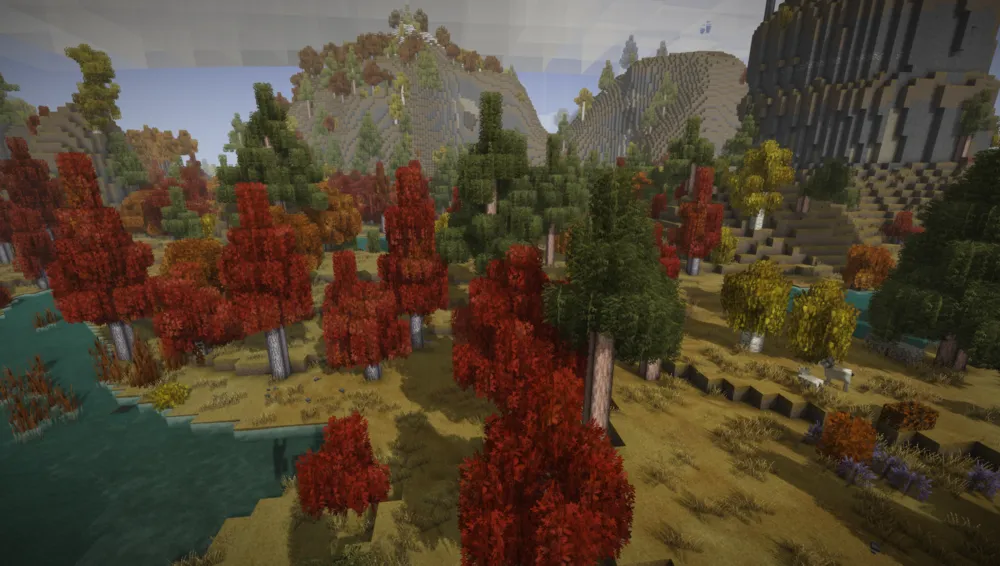
Seasons can be turned off when the world is created. “Seasons” can be “Off, always spring”, and the same for an endless summer, autumn, or winter. In an ordinary game they are “Enabled”: the temperature wanders, and snow piles up.
When to sow
Each crop has its own line. Cross it with cold or heat, and the farmland says so in red: “Cold damaged”, “Growth stunted due to cold”, or “Growth stunted due to heat”. The percent of produce that remains is written right there on the soil. The seeds still drop. The mark stays, even if tomorrow is milder.
A young crop that remains past its line for about two days dies. A ripe one caught by frost survives, and gives less. That is an ordinary world with “True winters” enabled: the cold cuts the harvest, fewer animals appear in winter, and they give less meat.
| Crop | When it suffers |
|---|---|
| Growing turnips | warmer than 27 °C |
| Growing rye | colder than −12 °C or warmer than 27 °C |
| Growing carrots | colder than −10 °C or warmer than 32 °C |
| Growing onions | colder than −1 °C |
| Growing cabbage | warmer than 35 °C |
| Growing rice | colder than 8 °C or warmer than 46 °C |
| Pineapple plant | colder than 6 °C or warmer than 48 °C |
For rye and carrots, a young crop after such a blow yields 75%, and a ripe one taken by frost yields 50%. For the others, the farmland itself writes the percent. Turnips are happier sown while it is still cool: summer becomes too warm for them easily. Rice and pineapple want the heat, and they mind even a mild chill.
Farming in Vintage Story: farmland, moisture, and fertilizer
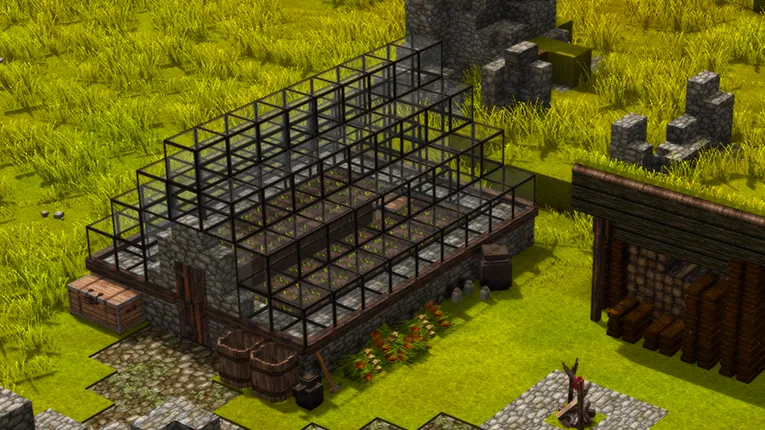
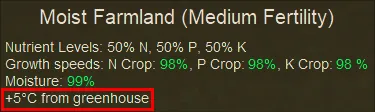
A greenhouse stretches the season. The game accepts it when the room is closed and at least half the roof is Glass: full blocks, slabs, or chiseled glass with at least one face left solid. The inside is at most 14×14×14 blocks. The walls can be anything, and neighboring greenhouses can share them. A glass slab goes in with its solid face toward the room. Farmland, fruit trees, and berry bushes in that room gain five degrees. The soil shows it as its own line: “+5°C from greenhouse”.
Why winter stops everything
At zero and below, bees go still: swarming and honeycomb both wait for warmth. At −10 °C the wait for honey starts over. Fruit trees often need that cold the other way around: without a cold spell, many of them will not flower again.
Snow stacks in layers, and a deep drift becomes a solid block of snow. A Snow shovel lifts it off the ground. Once the air rises even half a degree above zero, the snow starts to melt, faster in dry weather than in wet.
How to keep from freezing
The body stays near 37 degrees. In an ordinary world, “Body temperature hardiness” is 0 °C: that is what you can bear with no clothes, dry, standing still. Clothes add their own. The tooltip line is “Max warmth”. Armor is left out of that sum. Five degrees of clothing means you can stand outside at −5 °C. On the road, clothes wear down a little as you walk.
A soaked person feels colder, by as much as thirteen and a half degrees. Under an open sky, rain wets you quickly, and snow about twenty times more slowly. You climb out of the water soaked through. Drying takes about an hour, and about twice as fast beside a fire. A hat can shed some of the rain.
A closed room with a roof warms you on its own: the cold outside stops pulling your body temperature down. A Firepit (Lit) warms the space beside it, and inside such a room that warmth reaches farther than it does in the open. A glass-roofed greenhouse is a room too, once it is closed: you are warm inside, and the crops are another five degrees warmer than the air outside.
If the body falls about four degrees and stays there for three hours, with true winters enabled, “frost” damage begins: 0.2 every ten seconds. The character shivers. Warm up even briefly, and those three hours start over. Once the cold has already reached damage, a long run can add up to five degrees. It is no substitute for a house.
Temperature is described from the wiki Temperature, the seasons from the wiki Seasons.