


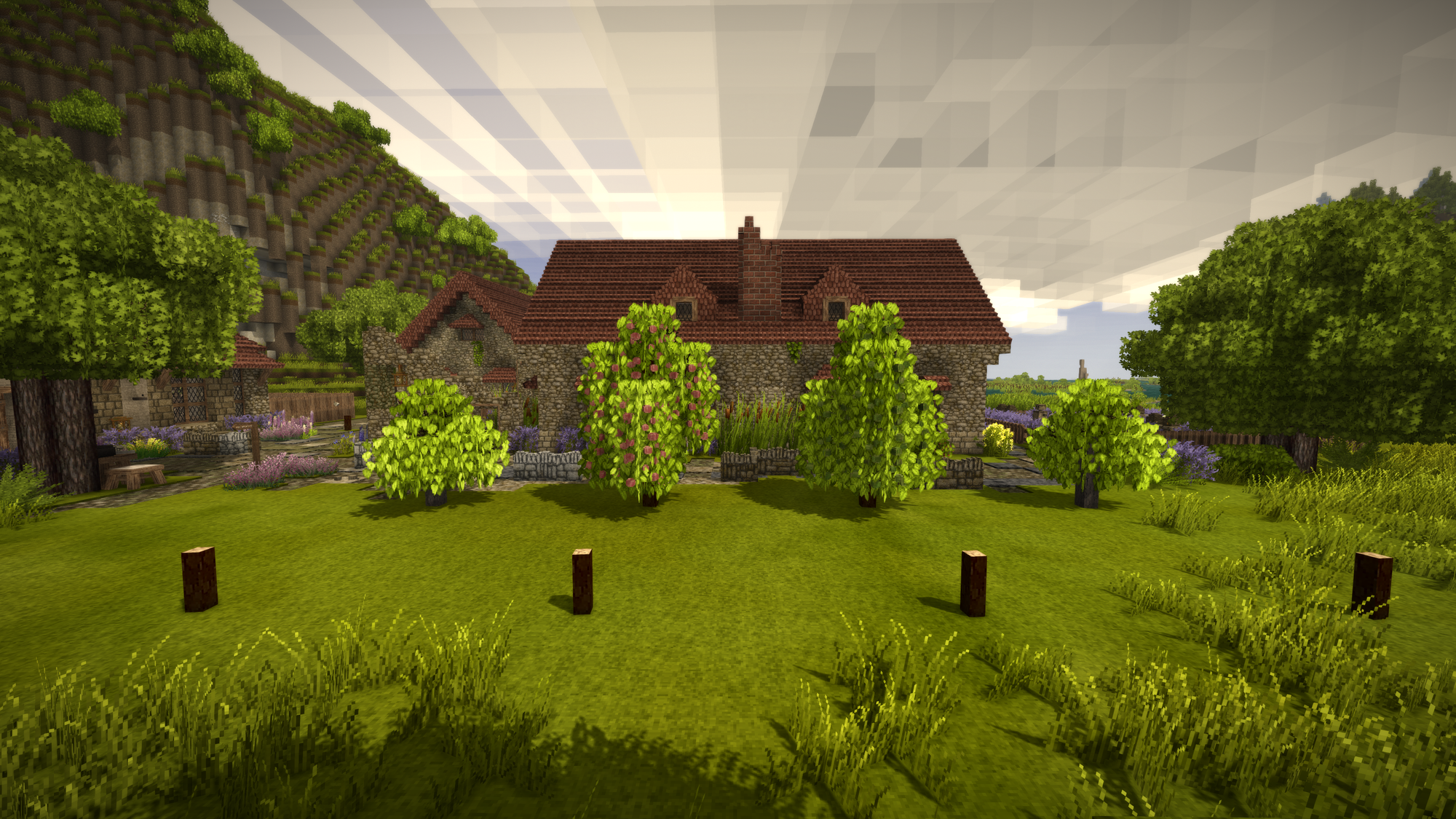
Vintage Story has two different kinds of tree. A fruit tree grows from a cutting, flowers once a year, and gives fruit from its leaves. A lumber tree grows from a seed into a sapling and gives logs. Farmland and the hoe do not apply to either. Blueberry, currant, and strawberry bushes are separate too: they use bush cuttings.
Recognizing a fruit tree
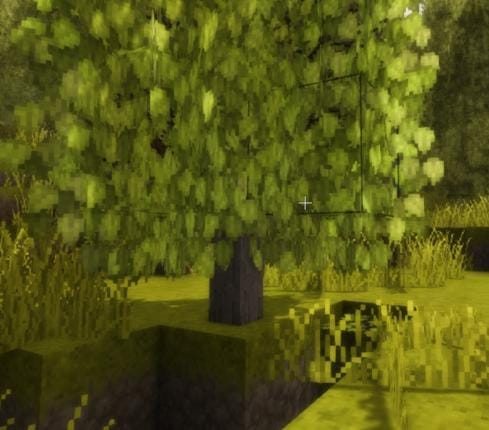
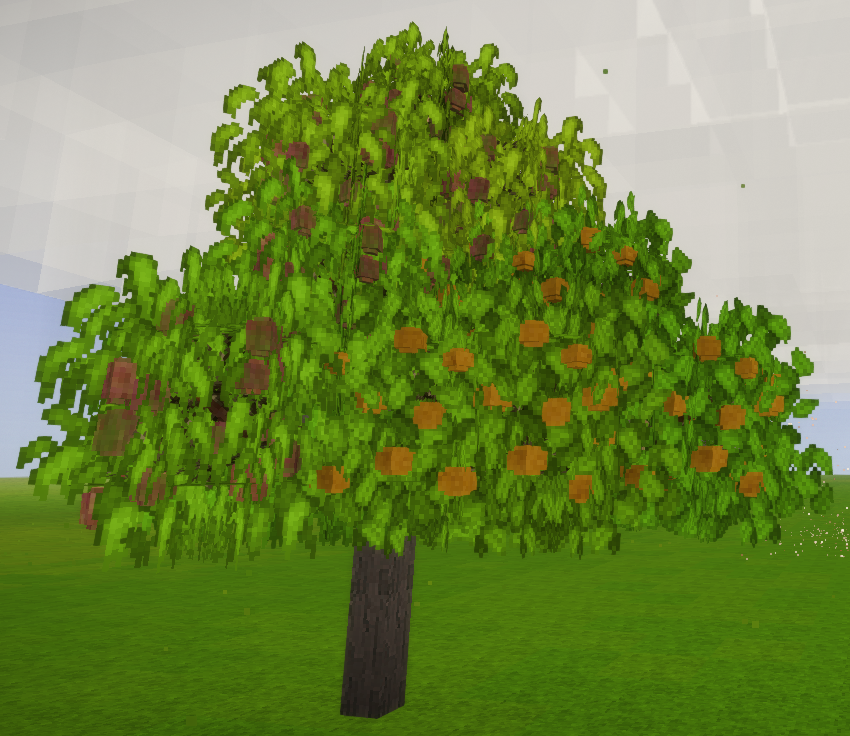
In a forest it is easy to walk past one until it flowers. The stem is slimmer than a normal log and does not fill the whole block, and the leaves use their own pattern. On the map the crown often reads as a cross, though neighboring trees hide that cross. The command /wgen pos climate shows the yearly average temperature and rainfall of a spot. That is not the temperature on the character screen.
| Tree | Temperature | Rainfall |
|---|---|---|
| Red apple tree | −9…18 °C | 0.5–0.9 |
| Pink apple tree | −5…18 °C | 0.5–1 |
| Yellow apple tree | 0…22 °C | 0.6–1 |
| Peach tree | 10…17 °C | 0.55–1 |
| Pear tree | −10…19 °C | 0.5–1 |
| Cherry tree | 0…24 °C | 0.6–1 |
| Orange tree | 25…30 °C | 0.45–1 |
| Olive tree | 22…50 °C | 0.3–0.5 |
| Mango tree | 28…50 °C | 0.6–1 |
| Breadfruit tree | 28…50 °C | 0.6–1 |
| Lychee tree | 22…50 °C | 0.6–1 |
| Pomegranate tree | 22…50 °C | 0.3–0.7 |
Cuttings
The tree is a stem, branches, and leaves. An axe on a branch drops one cutting: “Red apple tree cutting”, “Mango tree cutting”, and the same pattern for the rest. A mature stem drops one firewood. Empty leaves drop nothing. A removed branch can grow back. The check runs about every 5 days.
A cutting goes on soil, sand, or gravel. On a bad spot the game says: “A tree cutting must be placed on soil or grafted onto a branch”. The chance to take root in the ground is 40%. Success becomes a “Young … tree stem” and one leaf. Failure becomes a “Dead tree cutting”, and breaking it drops 2 firewood.
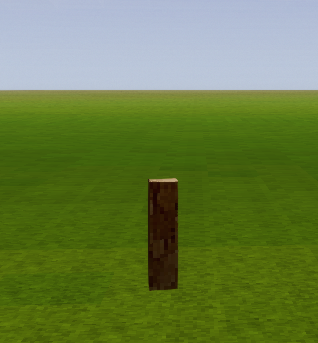
Growth is checked about every 5 days, sometimes 4 or 6. The first successful check changes nothing. The second, around day 10, decides whether the cutting lives. After that the tree alternates between growing taller and filling out the crown, up to 6 blocks high and 2 blocks of leaves out from the stem. The lower leaves of a tall crown disappear. A tree sometimes skips a branch, so a graft cut is not on every level.
Growth happens only when noon is at least 12 °C and the tree is not dormant. A greenhouse adds 5 °C to the temperature it measures, shown as “+5°C from greenhouse”. A 14×14 greenhouse floor holds five of these trees without crowding: four in the corners and one in the center.
Grafting
A cutting can be grafted onto a living fruit tree. The host needs an open cut: a horizontal stub on the stem. Break the leaf and the branch that sit sideways against the stem. If the center block still reads as a branch, that spot is too young.
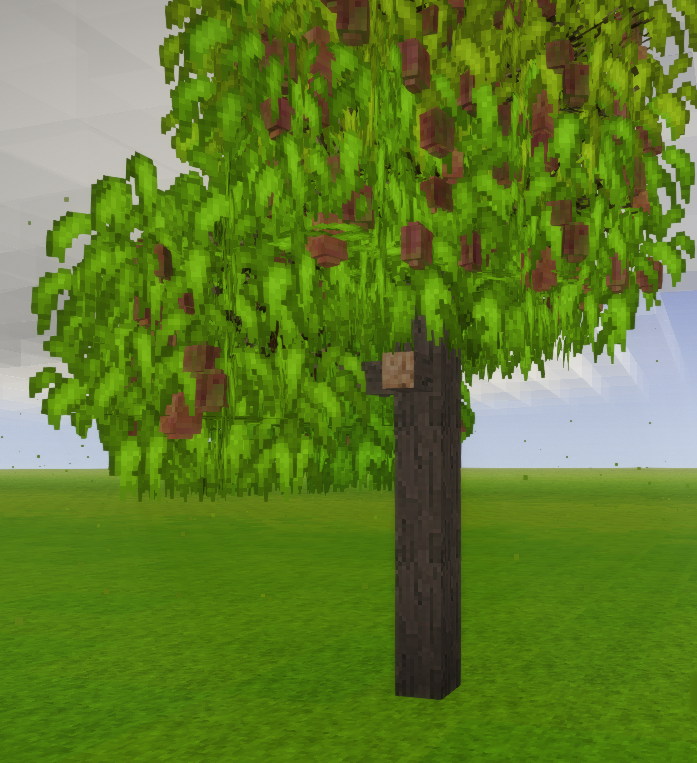
Graft with Shift and right-click on the cut. The chance of union is 60%. A successful cutting becomes a branch of its own species and grows up to six of its own leaves. A normal crown reaches 2 blocks out from the stem. A grafted branch can reach 3.
The graft keeps its own cold limits and its own flowering time. An apple and a mango do not belong on the same trunk. The game refuses a mix of deciduous and evergreen. The message is “Cannot mix decidious with evergreen trees”.
Deciduous trees
Red, pink, and yellow apple, cherry, peach, and pear go dormant for the winter. Dormancy is when vernalization happens: the tree must bank hours of cold, then meet a warm day. The counter is 220–280 in-game hours, 250 on average. A cutting that has not yet become a stem, and has not united with a host, does not bank those hours. When the hours are done, the tooltip reads “Dormant (Vernalized)”. Without that line, a warm day wakes the tree empty, with no flowers.
While dormant, a deciduous tree survives another 3 °C below its stated die-below threshold. The table shows averages. Each tree rolls its own value. The parentheses are the full spread.
| Tree | Dies below | Vernalization, below | Enters dormancy | Leaves dormancy |
|---|---|---|---|---|
| Red apple tree | −28 (−38…−28) | 2 (1.5–2.5) | −3 (−5…−1) | 19 (14–24) |
| Pink apple tree | −24 (−34…−24) | 3 (2.5–3.5) | −3 (−5…−1) | 19 (14–24) |
| Yellow apple tree | −22 (−32…−22) | 4 (3.5–4.5) | −3 (−5…−1) | 19 (14–24) |
| Cherry tree | −20 (−30…−20) | 5 (4.5–5.5) | −3 (−7…1) | 19 (14–24) |
| Peach tree | −12 (−22…−12) | 5 (4.5–5.5) | −3 (−5…−1) | 19 (14–24) |
| Pear tree | −28 (−41…−28) | 2 (1.5–2.5) | −4.5 (−6.5…−2.5) | 19 (14–24) |
A red apple enters dormancy somewhere around −5 °C to −1 °C. It then needs hours colder than about 2 °C. When the temperature rises toward 14–24 °C, a vernalized tree flowers.
Evergreen trees
Orange, olive, mango, breadfruit, lychee, and pomegranate have no dormancy. They flower by the calendar, not by a cold spell, and they die in milder cold. There are no flowers in the first 30 days after rooting or grafting. After that, flowering falls in a window of about two weeks around a fraction of the year: mango near 0.2, olive, breadfruit, lychee, and pomegranate near 0.3, orange near 0.5.
| Tree | Dies below | Flowering, year fraction |
|---|---|---|
| Orange tree | 6 (1–6) | 0.5 |
| Olive tree | 7 (2–7) | 0.3 |
| Mango tree | 10 (6–10) | 0.2 |
| Breadfruit tree | 10 (6–10) | 0.3 |
| Lychee tree | 10 (6–10) | 0.3 |
| Pomegranate tree | 10 (6–10) | 0.3 |
Flower, fruit, harvest
Deciduous trees have five states: “Dormant”, “Empty”, “Flowering”, “Fruiting”, and “Ripe”. Evergreens skip dormancy. The leaves use the same words: “dormant”, “plain”, “flowering”, “fruiting”, “with ripe fruit”. Flowering lasts 3–6 days for every species, 4.5 on average. The later stages are fixed and show on the block tooltip. Ripe fruit left on the tree disappears, and the leaves go empty again.
Harvest with right-click on a leaf that holds ripe fruit. The leaf stays, the fruit goes into the inventory. The count below is the average from one leaf block. A given tree varies around that average.
| Tree | Fruiting, days | Ripe, days | Per leaf | Fruit |
|---|---|---|---|---|
| Red apple tree | 18 | 12 | 4 | Red apple |
| Pink apple tree | 21 | 9 | 6 | Pink apple |
| Yellow apple tree | 23 | 10 | 5 | Yellow apple |
| Peach tree | 17 | 8 | 5 | Peach |
| Pear tree | 20 | 28 | 5 | Pear |
| Cherry tree | 11 | 9 | 8 | Cherry |
| Orange tree | 60 | 12 | 5 | Orange |
| Olive tree | 40 | 24 | 4 | Olives |
| Mango tree | 50 | 10 | 4 | Mango |
| Breadfruit tree | 50 | 10 | 3 | Breadfruit |
| Lychee tree | 50 | 10 | 8 | Lychee |
| Pomegranate tree | 50 | 10 | 5 | Pomegranate |
How long the fruit stays fresh in the inventory depends on the item.
Food preservation in Vintage Story
Forest saplings
Oak, pine, birch, and the other lumber species are planted from a seed, not a cutting. Seeds drop from leaves. Branchy leaves drop them more often than plain leaves. An axe on the trunk fells the whole tree and leaves very few seeds, so strip the foliage first. Shears break leaves in a 3×3 square. They do not raise the seed chance. They only speed the harvest. Sticks come off foliage the same way. A leaf with no branch yields no sticks.
A seed on soil becomes a sapling in 2–4 days, 3 on average. Breaking the sapling drops the sapling, which is how you move it. The days below start at the sapling:
| Species | Days |
|---|---|
| Oak, pine, birch, maple, crimson maple, acacia, kapok, larch, bamboo, cypresses | 10–18 |
| Walnut | 24–32 |
| Purpleheart | 44–52 |
| Ebony | 50–58 |
| Redwood | 50–90 |
A 2×2 of saplings does not grow into a giant oak. Old oaks and large kapoks exist only from world generation. A redwood sapling does grow the thick trunk: the trunk drops “Redwood quarter log”, and a normal “Redwood log” comes off the branches. A Mediterranean cypress log breaks into firewood, not a log you can saw.
Oak logs and acacia logs are the only logs that brew tannin in a barrel.
Leather in Vintage Story: lime, tannin, and the barrel
Resin comes off “Leaking pine log with resin” or the same acacia log: right-click, and the inventory item is “Resin”. Bamboo drops a “Bundle of bamboo stakes”, not logs. Firewood and logs feed a charcoal pit.
Wild beehives sometimes sit in the foliage. The bees are audible before the block is visible. Breaking the hive yields honeycombs, and that hive does not return.
Fruit trees follow the Fruit tree wiki page, and lumber trees follow the Tree page.