


The food can be eaten without cooking. However, the player should not rely on these items for too long, as once harvested, natural food sources either disappear forever or take a long time to regenerate. The cooking pot is worth making because the same ingredient gives more satiety inside a meal and fills more than one nutrition bar. The green satiety bar above the hotbar holds 1500. While it is not already full, eating raises nutrition: 100 satiety adds 40 points of that food's category. A meal eaten on a full bar adds no nutrition.
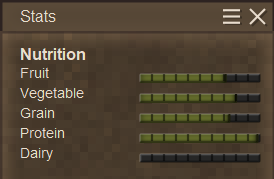
Nutrition is the character window section of that name: fruit, vegetable, grain, protein, and dairy. Each full bar adds 2.5 health, and all five add 12.5. The bars fall on their own over time. Dairy falls slower than the others.
Pot and firepit
Form a cooking pot and a bowl from clay and fire them. The clay color does not change the cooking. An Earthy brown ceramic cooking pot and a Black ceramic cooking pot boil the same meals. You cannot eat from the pot. A bowl scoops one serving: use the bowl on the pot while it is placed, on a shelf, or in the inventory.
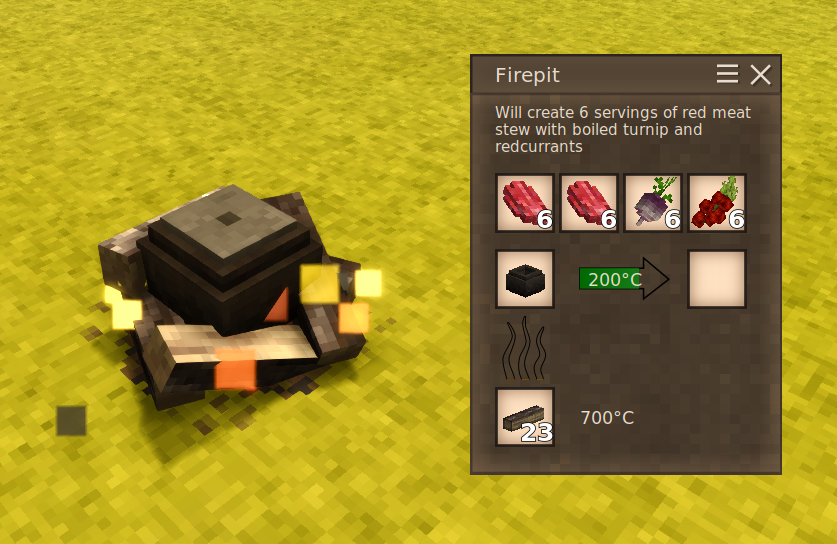
A firepit is dry grass plus four firewood, lit with a firestarter or a torch. Set the pot on the firepit and open the firepit window. It has four slots, and each slot holds up to 6 items. The number of servings equals the stack size, and every filled slot has to hold the same count. Six and six cooks six servings. Six and four does not cook. The pot stops at six servings.
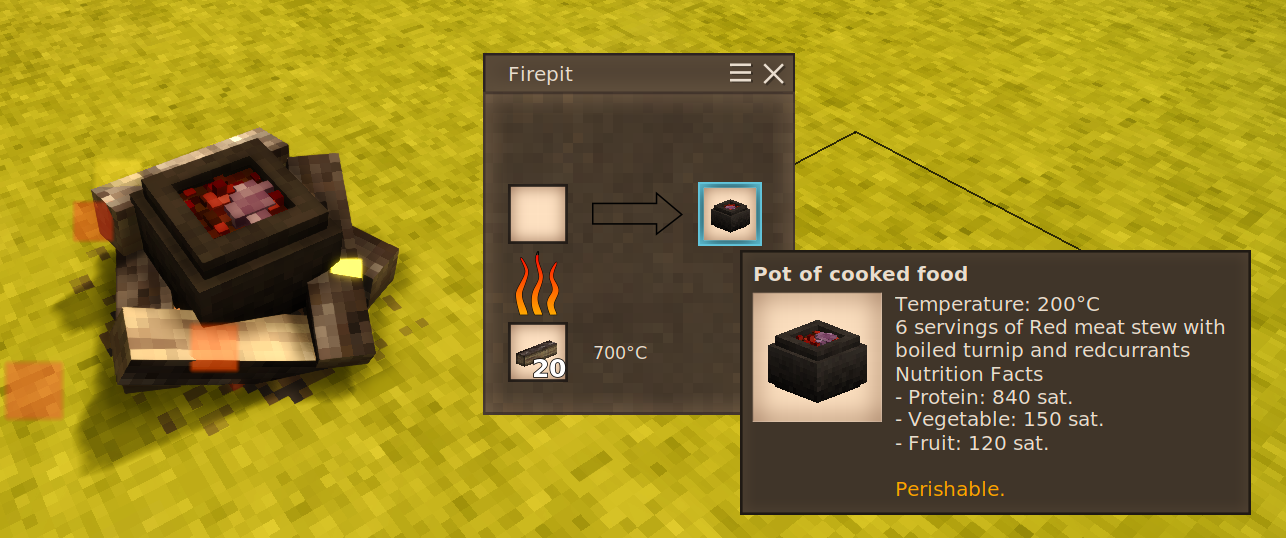
When the stacks match a meal, the window names it. The finished pot appears at the 200°C mark. The firewood's own heat is shown apart from that mark.
The six meals
| Meal | What goes in | Stays fresh |
|---|---|---|
| Vegetable stew | Two slots of vegetables, mushrooms, soybean, peanuts, or a pickle, in equal stacks. One or two more of the same kind of slot if you want them | 6 days |
| Meat stew | Two slots of raw red meat, raw poultry, or raw fish. Cured meat works too. After that you can add more meat, a vegetable, a raw chicken egg, one slot of fruit, and 0.2 L of honey per serving | 6 days |
| Porridge | Two to four slots of grain, in equal stacks. Empty slots take a vegetable, fruit, and 0.2 L of honey per serving | 4 days |
| Soup | 1 L of water per serving and one slot of vegetables. More vegetables after that, and one slot of meat, fish, poultry, or egg | 6 days |
| Scrambled eggs | Two slots of raw chicken egg, in equal stacks. More eggs, a slice of cheddar, a slice of blue cheese, or a vegetable can follow | 4 days |
| Jam | Two slots of fruit and two slots of honey, 0.2 L of honey per serving in each honey slot | 45 days |
Pour water and honey from a container with the left mouse button, and pick them back up with the right. Soybean and peanuts sit in the vegetable slots, and their satiety counts as protein. The pot takes processed cassava. The raw root does not fit. A poisonous mushroom stays poisonous in the stew. Leave the death cap out of the pot.
The meal's name describes what you put in. It does not add satiety by itself. Two slots of the base make an ordinary meal. Three slots of the base make it hearty, four make it hefty. Porridge then reads as hearty rye porridge or hefty rye porridge. Stew reads as hearty stew or hefty stew. Scrambled eggs read as hearty scrambled eggs or hefty scrambled eggs. Soup turns hearty when the same vegetable fills three slots. Honey shows up in the name as a topping.
Satiety in one serving
A serving adds up every ingredient in the table. Two slots count twice. The next picture is that sum: two red meat make 840 protein, the turnip makes 150 vegetable, and the redcurrants make 120 fruit.
| One item in the serving | Satiety | Nutrition |
|---|---|---|
| Cabbage | 450 | Vegetable |
| Carrot, onion, turnip, parsnip | 150 | Vegetable |
| Pumpkin slice | 180 | Vegetable |
| Cassava | 120 | Vegetable |
| Fennel | 60 | Vegetable |
| Raw red meat, cured included | 420 | Protein |
| Raw poultry | 375 | Protein |
| Raw chicken egg | 200 | Protein |
| Soybean | 240 | Protein |
| Peanuts | 210 | Protein |
| Rice grain | 280 | Grain |
| Rye grain, spelt grain, amaranth grain, sunflower grain | 240 | Grain |
| Flax grain | 120 | Grain |
| Apple, currants, and other ordinary fruit | 120 | Fruit |
| Cherry, lychee | 60 | Fruit |
| Cranberry | 90 | Fruit |
| Cheddar cheese, 1 slice | 360 | Dairy |
| Blue cheese, 1 slice | 300 | Dairy |
Rice eaten raw is 75 satiety. In porridge it is 280. Cabbage eaten raw is 300. In a stew it is 450. One serving of two cabbages is therefore 900 satiety, most of the 1500 bar, and all of it goes to vegetable. Meat and cabbage in the same stew feed two bars.
Sprinting spends satiety faster than walking. Standing still for a few seconds cuts the drain to a quarter. Outdoors below 2°C, cold adds still more hunger. A closed room removes that extra.
After it is cooked
A bowl takes one serving. A crock takes several and sits on a shelf. Jam stays fresh 45 days, vegetable stew, meat stew, and soup stay fresh 6 days, and porridge and scrambled eggs stay fresh 4 days. After that the meal becomes rot.
To empty a pot without eating, toss it into water. Rot comes out the same way. A pot used for glue or another inedible boil ends up residue-covered, such as a Residue-covered black ceramic pot. Water does not clean that residue, and the pot no longer cooks meals.
Vegetables and grain come from the fields, meat, eggs, and cheese from the animals, and fish from the rod.
Farming: farmland, moisture, and fertilizer
The pot and the meals are described from the wiki Cooking and Meal, the cooking pot from the wiki Cooking pot, and satiety and nutrition from the wiki Satiety.