


Mechanical power in Vintage Story is rotation. A windmill or a water wheel turns an axle, the axle reaches a machine, and the machine works on its own: a quern grinds grain, a helve hammer knocks the slag out of an iron bloom, and a pulverizer crushes stone the quern will not take. One rotor can run several machines, when the torque is enough and the axles actually reach them.
The windmill
The small windmill is a Wooden windmill rotor and ordinary Windmill sails. The rotor is cut with a hammer and a chisel from two logs, resin and a lump of rendered fat. One set of sails is four sails: four support beams, six sticks and four linen. A wooden rotor takes up to five sets.
The large windmill is a Metal windmill rotor and a Large windmill sail. The rotor's handbook entry says the beams have to be a strong wood: oak, maple, kapok, redwood, ebony, walnut or purpleheart. The rotor's metal is iron, meteoric iron or steel: four rods, four heavy brackets and four support beams. Large sails are made in fours, from eight of those beams, twelve boards and eight linen. A metal rotor takes up to ten sets.
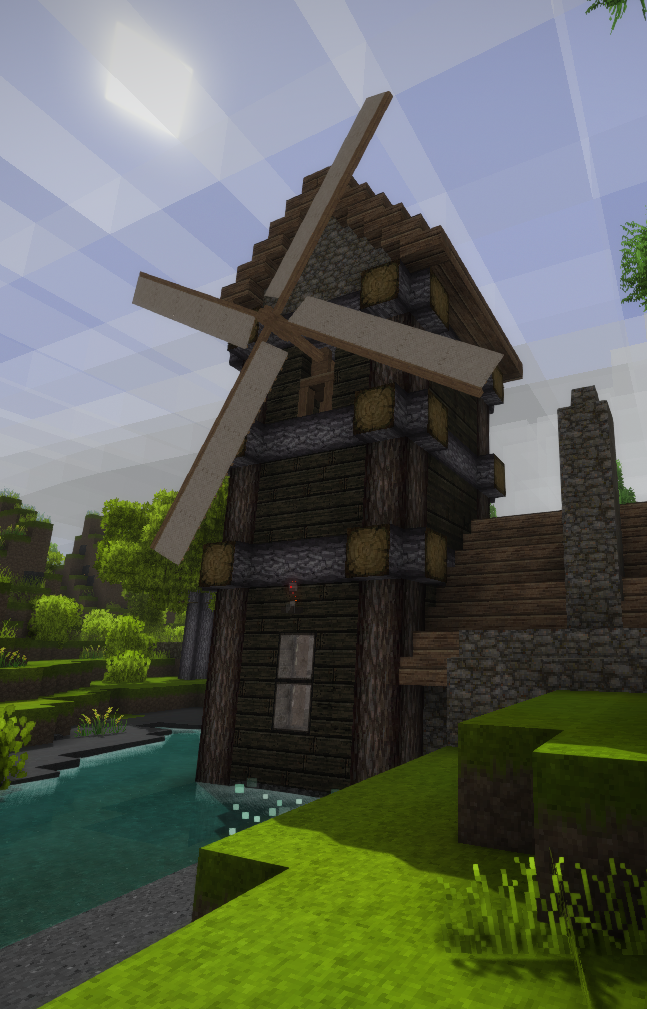
Place a Wooden axle first, then the rotor on its outer end, so the rotor has something to sit on. Four sails are added with a right click on the rotor. The prompt is Add sails. If there is not enough room, the game says "Cannot add more sails. Make sure there's space for the sails to rotate freely". The rotor needs an empty square with room for the sail length. The four corners of that square can stay solid, and snow does not catch the sails. If a sail does hit a solid block, every sail on that rotor drops.
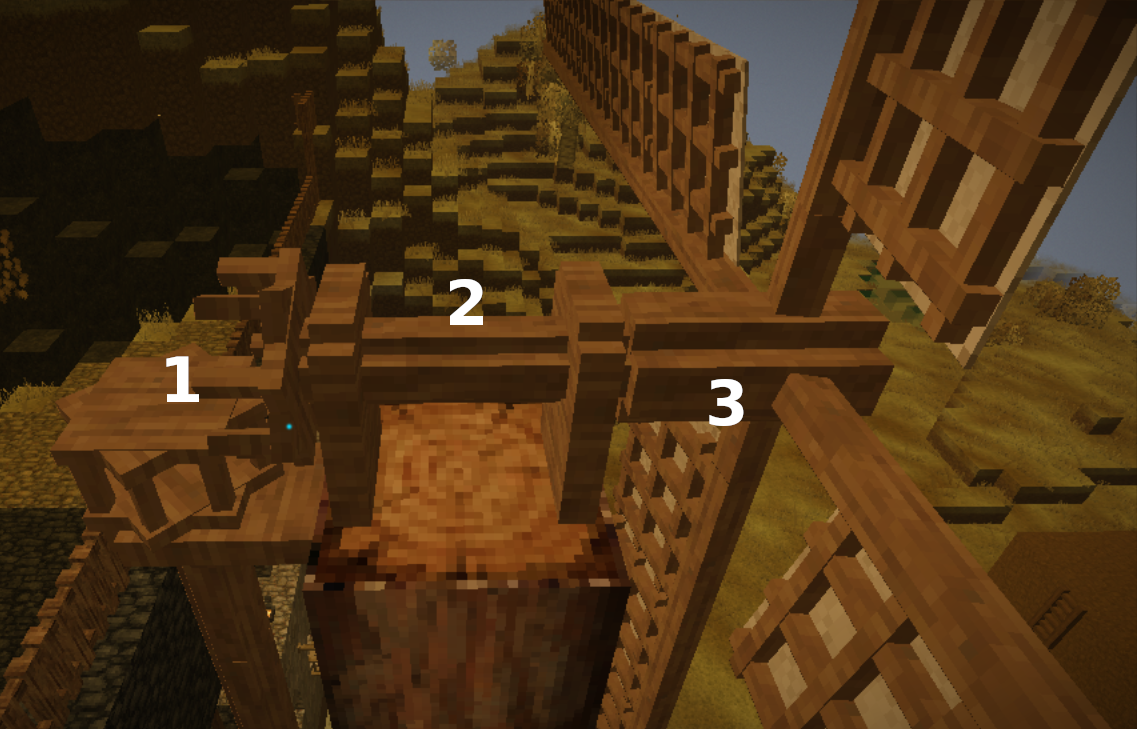
The rotor shows two lines. "Wind speed: {0}%" is the wind right now. "Sails power output: {0} kN" is what the sails themselves provide. Wind is not folded into the kilonewtons: the same number of sails always shows the same figure, and the wind separately decides how fast the rotor is allowed to spin. More sails do not raise that ceiling. They add torque, so the mill starts in a lighter wind and under a heavier machine. A set is 20 kN on a wooden rotor and 25 kN on the rotor made for large sails.
| Sets | Wooden windmill rotor | Metal windmill rotor |
|---|---|---|
| 1 | 20 kN | 25 kN |
| 2 | 40 kN | 50 kN |
| 3 | 60 kN | 75 kN |
| 4 | 80 kN | 100 kN |
| 5 | 100 kN | 125 kN |
| 10 | — | 250 kN |
The rotor needs sunlight. Indoors, in the shade of a mountain and underground, the wind on it falls to zero. Underground windmills are a world setting, /worldconfig undergroundWindmills true. A taller tower usually shows a stronger wind on the first line.
Two rotors close together halve each other's power. Each has a turbulence radius of its sail length times 1.5. The mills interfere while the distance between them is shorter than the sum of those radii. Two wooden mills with five sets need at least 15 blocks between them, and two large mills with ten sets need 30. The tooltip then prints, in English, "Exposed to turbulence from nearby windmill, power output reduced by 50%".
The water wheel
The other source is the Small water wheel. The starter piece is a hammer, a wooden axle and two small 4-way hubs, in iron, meteoric iron or steel. The rest is built in place, and the beam wood decides the boards. First, 16 support beams of oak, maple, kapok, redwood, ebony, walnut or purpleheart. Then 48 boards of that wood and 4 resin, another 16 beams and 4 resin, 8 nails and strips, and another 48 boards and 4 resin. The last click finishes the wheel. Until it is finished, the current is already measured and the wheel still makes no power.
The wheel takes flowing water. Still water does not turn it, and the paddles need to stay clear: a blocked wheel stops almost at once. The axle leaves the wheel's shaft the same way it leaves a windmill rotor.
Axles and gears
A Wooden axle carries rotation in a straight line, horizontal or vertical. One log and a lump of rendered fat, with a hammer and a chisel, make two axles. An axle needs a support when you place it, or the game says "Cannot place this block here. The connecting axle must be attached to a block". The support can come away once the axle is held by the next part.
Angled gears turn the rotation through a right angle, a horizontal axle to a vertical one. They take a hammer, a saw, a chisel, a log, two sticks, resin and rendered fat. They only sit on an axle. If one will not place, put a block under the axle for a moment. The error is "Cannot place this block here. Can only be attached to axles".
Brake, clutch and transmission
A Brake sits in the axle line. A right click clamps it, the resistance climbs, and the whole train stops. Another click lets go. The brake takes a hammer, a chisel, a log, a wooden axle and two resin.
A Transmission sits in that same line and does not pass rotation by itself. Beside it, on the flank and not along the axle, goes a Clutch, facing the transmission. A right click on the clutch closes that branch, and another click opens it. That is how one machine drops out and leaves the torque for another. The clutch takes a hammer, a chisel, a saw, eight boards, a log, eight sticks, two resin and two lumps of rendered fat. The transmission takes a hammer, a chisel, a saw, two angled gears, eight boards, two resin and rendered fat.
The large gear
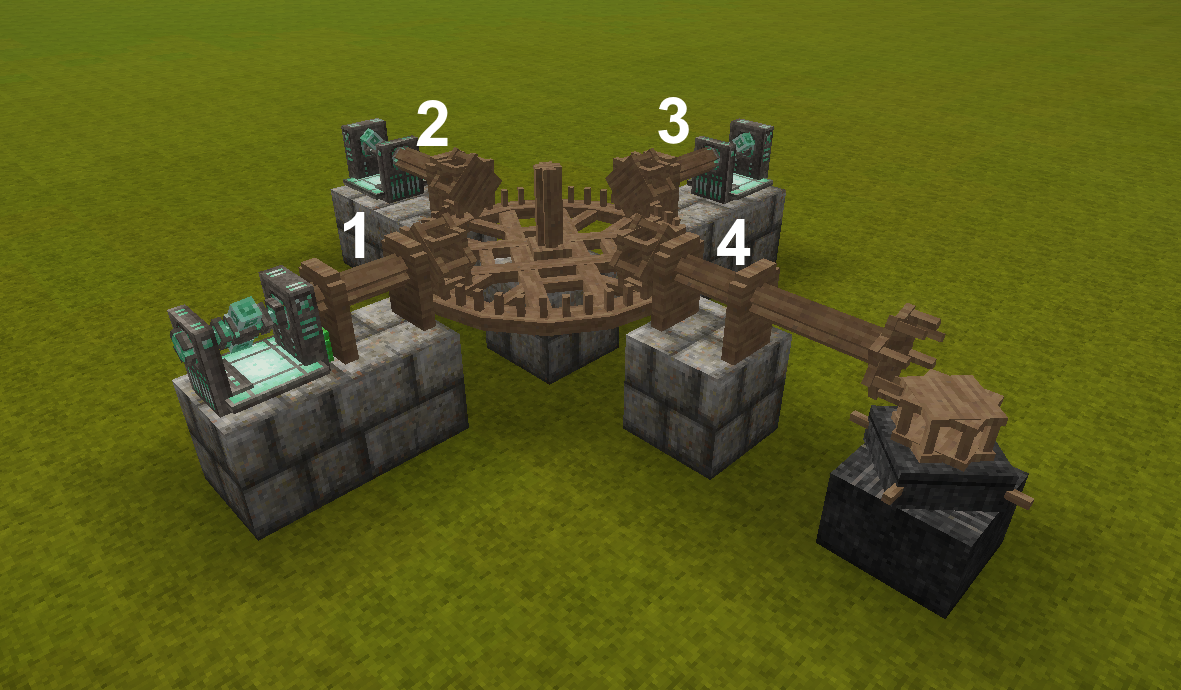
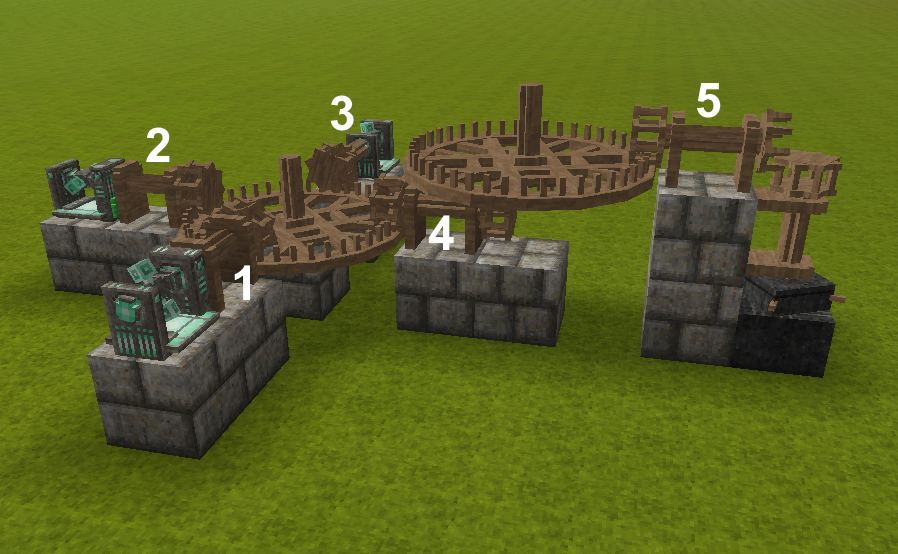
A Large wooden gear lies flat. It cannot be placed vertically. A vertical axle passes through the center, and angled gears sit against the rim. The ratio is 5.5.
An axle into the center and an output off the rim multiply speed by 5.5 and divide torque by the same amount. An input on the rim and an output through the center do the opposite: 5.5 times the torque, and speed divided by 5.5. Several windmills brought onto the rim add their torque together, and the speed follows the fastest of them. One input on the rim can be split to several outputs, and the speed and torque stay as they are.
First comes a Large gear section: a hammer, a chisel, a saw, five boards, twelve sticks and two resin. The gear itself is four sections, 24 boards and a wooden axle.
What resists
While the torque is below the resistance of the machines, the whole train slows or stops. Axles and gears barely count. The heavy parts are the quern, the pulverizer and the helve hammer. Extra torque comes from more sails, a second wheel, or the large gear arranged for torque. Extra speed comes from that same gear arranged for speed, and only while the torque still holds.
| Part | Resistance |
|---|---|
| Wooden axle, angled gears, transmission | 0.0005 |
| Windmill rotor, small water wheel | 0.003 |
| Large wooden gear | 0.004 |
| Archimedes screw | 0.015 |
| Pulverizer | 0.085 |
| Quern | 0.1 |
| Helve hammer, once the hammer is mounted | 0.125 |
The quern
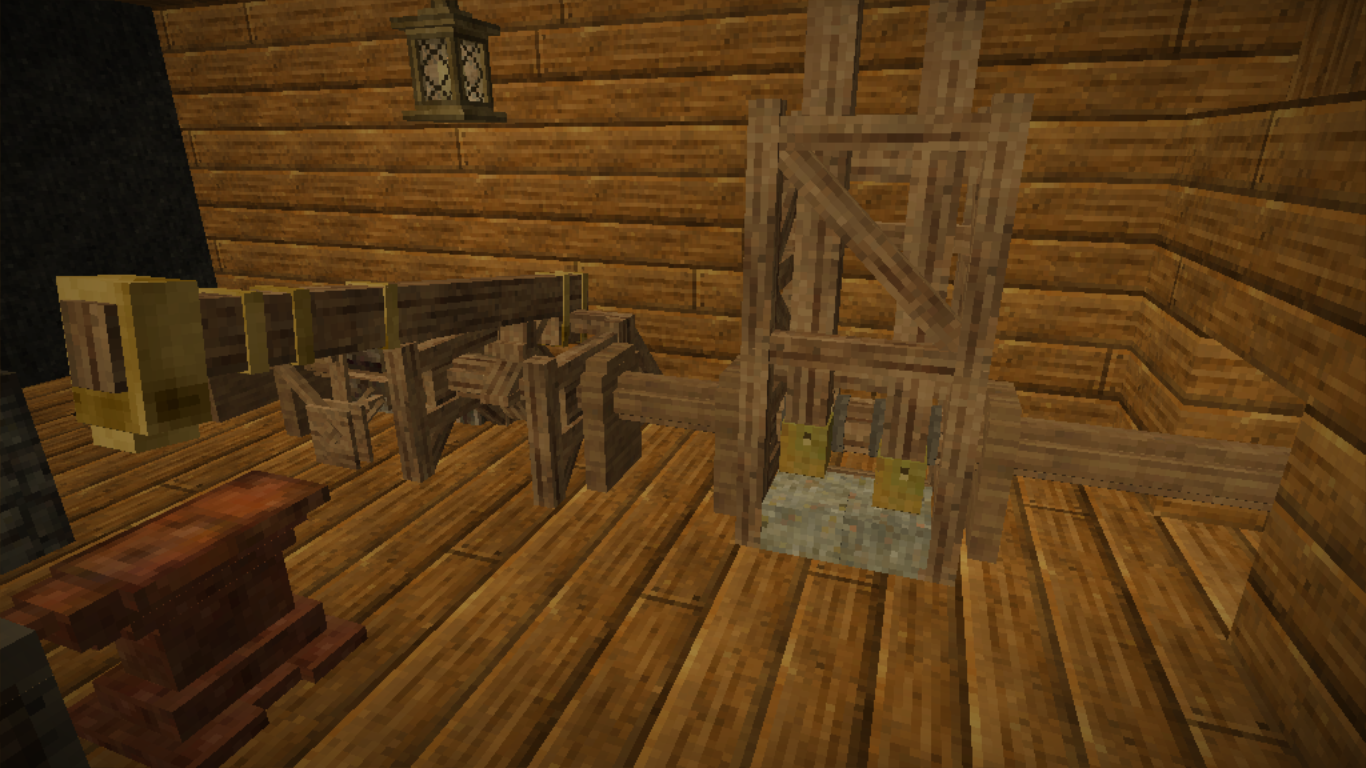
A quern grinds grain and soft stone. The stone in the recipe is granite, andesite, basalt or peridotite: four blocks, a stick, a hammer and a chisel. The finished block is named for the stone, such as Granite Quern. A right click turns it by hand. Add/Remove items puts grain in and takes the grind out, and Grind is the wheel itself.
For a windmill, the axle meets the quern at the top or the bottom. Once the output slot is full, the grind spills out of all four sides. A block against a side closes that side and slows the grinding, so hoppers go under the open sides. One Hopper on top feeds several stacks.
Farming: farmland, moisture and fertilizer
The helve hammer
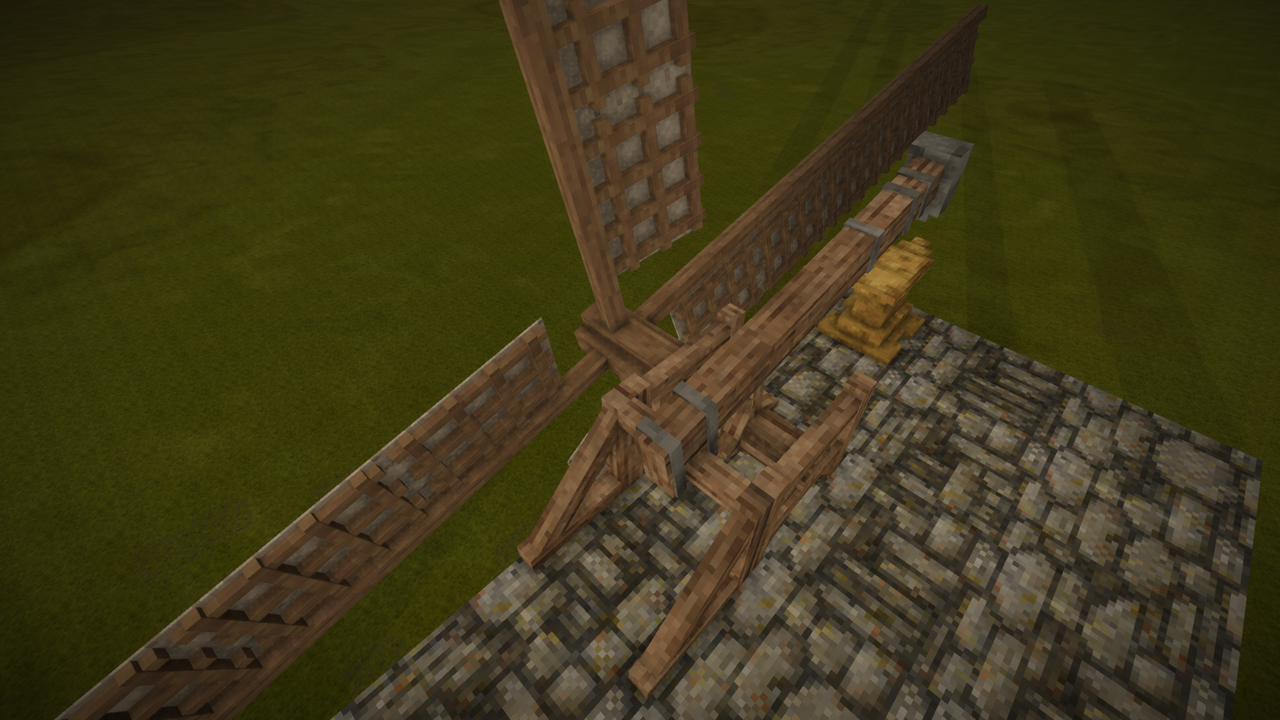
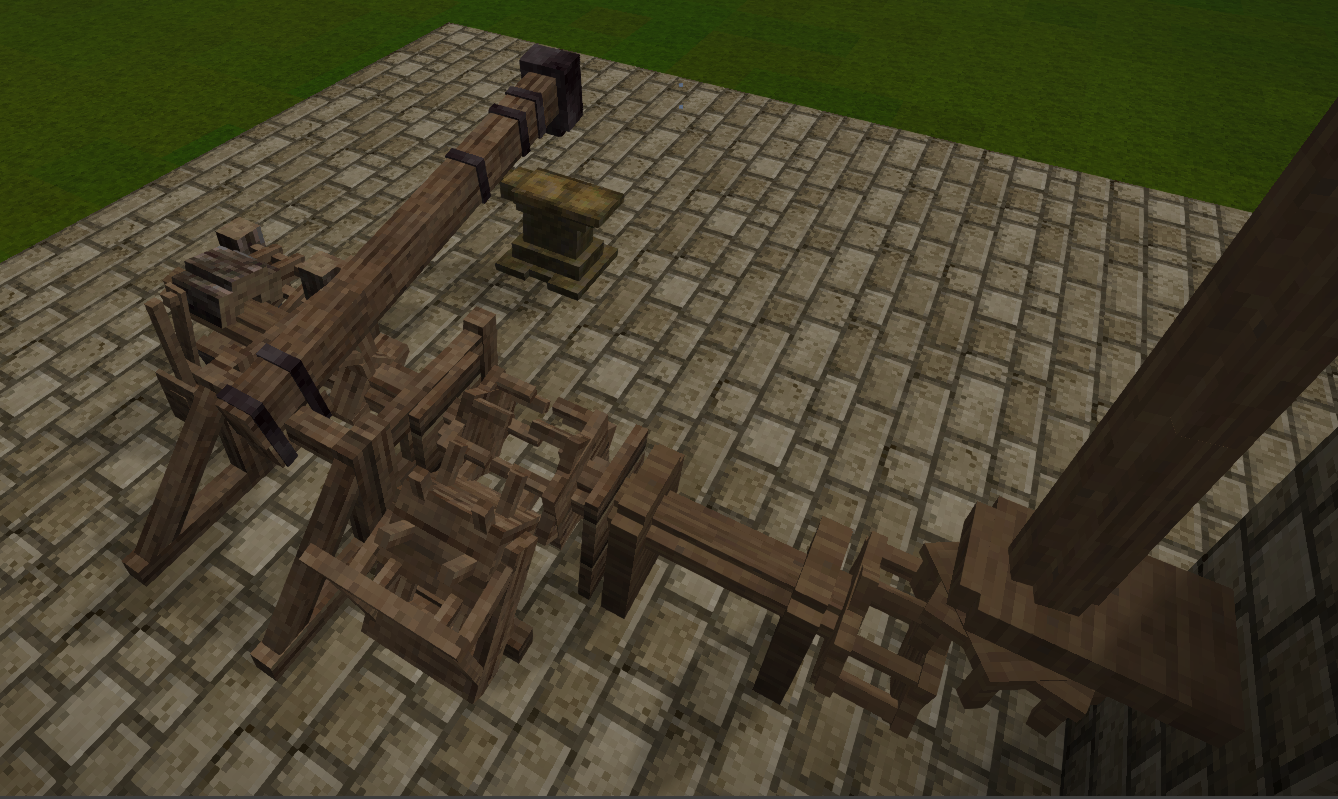
A helve hammer smiths metal plates, cleans iron blooms and works blister steel into ingots. It does not smith tools or weapons. The hammer's metal does not change the work: tin bronze, bismuth bronze, black bronze, iron, meteoric iron or steel. The head is cast or smithed, then eight boards are added to it.
Beside it you need a Helve hammer base and a Wooden toggle. The axle arrives at the toggle from the left or the right. The base goes against the toggle, and an anvil of bronze tier or better goes where the head will fall, three blocks out from the base. The hammer mounts on the base with a right click. If the arm faces the wrong way, turn the base before the hammer goes on. A brake, when you want one, sits on the free side of the base, opposite the incoming axle.
Steel: the cementation furnace and blister steel
The pulverizer
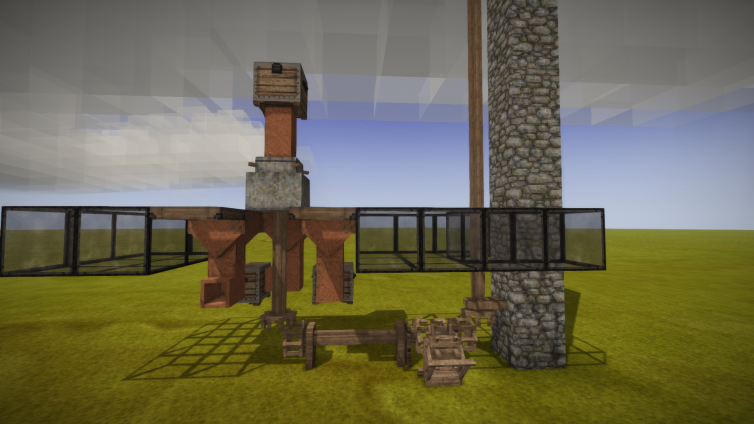
A Pulverizer frame is set on the ground: a saw, 42 boards, and a rock of granite, basalt, andesite or peridotite. The frame is tall and needs room above it. Then it takes a Pulverizer toggle, two Pulverizer pounders and two caps. The drive axle meets the pulverizer toggle from the side.
The toggle is a wooden axle and a metal plate. The plate can be tin bronze, bismuth bronze, iron, meteoric iron or steel. A pounder is cut from three logs. The caps are smithed, and they show a tier: bronze says Tier: 2, iron and meteoric iron say Tier: 3, steel says Tier: 4. Both caps go on together and at the same tier. Put them on before the pounders and the game says "Please add pounders before adding caps!".
What a stone becomes is written on the item itself: "When pulverized: Turns into {0}x {1}" and "Requires Pulverizer tier: {0}". Quartz, bauxite and the harder ores go here. They do not go in the quern. Input is at the front, under the pounders, and output is at the back. A hopper and an elbow chute feed the ore, and a hopper under the output takes it away. A block flush against the back throws the output out to the side.
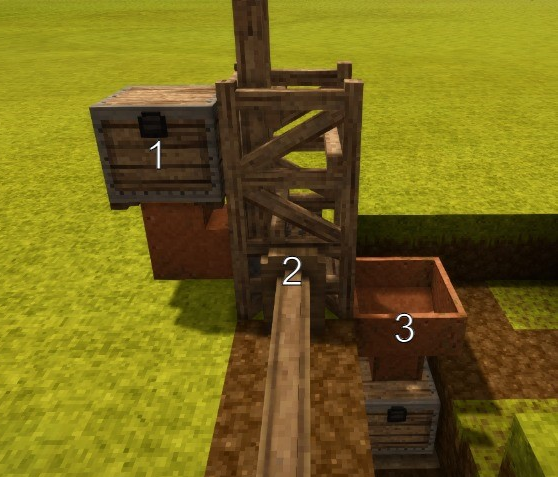
Hopper, chute and the Archimedes screw
A Hopper is three copper plates. A Chute Section is soldered: a soldering iron, a hammer, a copper plate and two bars of Lead solder bar or Silver solder bar make two sections. Two sections make a Straight Chute or an Elbow Chute. An item in a chute tries to go down first, travels no more than three blocks sideways, and then stops.
Items go upward through an Archimedes screw, or an Archimedes screw with port. That takes a hammer, shears, a metal plate and a chute section, and it needs the same rotation as the machines. A hopper and a chute keep working while you are nearby. Walk far enough away and the feed stops, and dropped items can disappear.
The windmill is described from the wiki Windmill, the power train, brake, clutch and large gear from the wiki Mechanical power, the quern from the wiki Quern, the helve hammer from the wiki Helve hammer, and the pulverizer from the wiki Pulverizer.